Sunday, August 28, 2011

3.4 Billion Year Old Microfossils? . . . Umm Yes (Probably)

Sshhh, be vewy vewy quiet. We’re hunting Awchean pwokawyotes.

There is good carbon and sulphur isotope geochemical evidence that life has existed on Earth from the early Archean. This life is thought to consist of small prokaryote cells with a penchant for sulphur instead of oxygen.

However, identifying actual fossil evidence is very tricky for a number of reasons. One of the major ones being, that given the 3.5 billion year time span and plate tectonics, few rocks from this period of Earth history remain on the surface. Of those that do, most either were unsuitable to preserve life in the first place (e.g. volcanic rocks) or have been metamorphosed until any possible organic trace has been cooked to oblivion.

So, if you want to go hunting Archean microbes you need to look in an area with rocks that have been relatively unmolested for some 3.5 billion years or so.

Presenting the Pilbura Craton, Western Australia. The Craton consists of (relatively) unaltered 3.7-2.6 billion year old rocks formed of a granite–greenstone terrane consisting of a series of dome shaped granitoid bodies, overlain by an extensive sequence of Archaean and later metasediments. Within the Craton, the East Pilbara Terrane contains a suite of approx. 3.4 billion year old sedimentary rocks which occur sandwiched between two suites of volcanic rocks.

This is the Strelley Pool Formation and is thought to be between 3426-3340 million years old. At the base of Formation, sitting unconformably on underlying 3515 million year old basalts, is a remarkably well preserved sandstone. (The ridge in the header image above. The red dots mark the position of the unconformity between the underlying basalts and the Strelley Pool Formation. Image (sans Elmer) from Wacey et al. 2011. Supplementary Information)

The sandstone is dark coloured at the base, due to it being carbonaceous- and pyrite-rich, where it sometimes fills channels eroded into the underlying basalt. Above this, the sandstone becomes lighter as the carbonaceous matter and pyrite disappear, before passing into overlying limestones - which contain possible stromatolites - and cherts.

Thin section photomicrograph showing multiple generations of carbonaceous material and silica cements within the Strelley Pool sandstone. DQ, detrital quartz grains. C1, carbon material, interpreted as a biolfilm, covering quartz grains. S1, first silica cement layer, up to c. 30 μm partially filling the void space between the detrital quartz grains. C2, A second carbon biofilm covering the surface of the S1 silica layer. S2, a second generation of silica cement precipitated in the larger pore spaces. C3, a third generation of carbon biofilm. (Wacey et al. 2011. Supplementary Information).
This fantastic thin section photomicrograph provides a wealth of information that allows us to reconstruct how the sandstone was formed. The grains are well rounded detrital quartz. Grains of detrital pyrite are also present. The grains are covered with a thin film of carbonaceous matter, and show a number of silica cementation events, some of which show a dripstone texture.

A second film of carbonaceous matter covers the primary silica cement layers. The central spaces between grains not occupied by the silica layers and carbon films, is filled with chert.

From this we can say that the well-rounded, large quatrz and pyrite grains suggest the sandstone was deposited in a high energy environment, such as a beach or estuary. The sandstone is also very clean - there is no fine material such as silt or clay - also supporting a high energy environment of deposition which would have washed out all the fine-grained material such as silt and clay.

The several episodes of silica cementation suggests cyclic inundation of silica-rich fluids into porous, clean sands.

Thin section showing b, Rounded quartz grain separated from a carbon-rich chert infilling by a dripstone cement (white arrow). c, Rounded grain of detrital pyrite (black grain) with a dripstone chert cement and carbon coating (red arrow). (Wacey et al. 2011).
The dripstone cements are exactly that, they appear as 'drips' of cement on the bottom on grains. This is because they form when the grains are exposed to air and trapped fluid flows to the bottom of the grains. This supports a beach-type environment which was influenced by valdose conditions - where non-marine groundwater is retained by adhesion to grains or by capillary action.

The evidence suggests then, that the sandstone was deposited in a nearshore beach-type environment which helped smooth out the quatrz and pyrite grains, and removed any fine material. During this time the first layer of carbonaceous material was formed around the grains (C1 above). Periodically, the highly porous sand came under the influence of valdose conditions, allowing the precipitation of silica cement around the grains (S1 above), trapping the carbonaceous layer, but maintaining the porous nature of the sand. Subsequently a second layer of carbonaceous material (C2 above) was formed over the S1 cement, possibly suggestive of a reversion to marine influences. A second round of valdose conditions produced a second cementation layer (S2 above). Followed by another return to marine influences and a third carbonaceous layer (C3 above). Finally, after the sands were buried, subsequent chert deposition provided the source for the last event, the filling of the remaining pore space with chert.

Before we look at the carbonaceous material in more detail there is the question of the link between the detrital pyrite grains and the carbonaceous matter.

The detrital pyrite grains are large, much larger than the possible cells in the carbonaceous matter, and are rounded. This suggests that the pyrite is not a product of possible organic activity. There is some pyrite within the carbonaceous matter, but this pyrite is much smaller and angular in shape - as expected if they have been precipitated as a result of organic activity. The detrital pyrite grains are also covered by the silica cement layers. The evidence suggests that the pyrite is primary - that is it was present as an original constituent of the sand - rather then being a product of organic activity. As the pyrite only occurs in the base of the sandstone, primarily in erosive channels in the underlying volcanics, it seems likely that the pyrite grains were formed from the erosion of underlying rocks and have been left behind as a lag deposit as pyrite grains are much heavier that similar sized grains formed from other materials like quartz. The renewed influx of sediment resulted in the pyrite grains mixing with the quartz grains to form a pyrite-rich basal sand. Subsequent deposts of sand did not have the pyrite grains and so were deposited free of pyrite and carbonaceous matter. Remember also that the 3.4 Bya atmosphere has precious little in the way of free oxygen, so the pyrite would be quite stable under surface conditions.

Since the detrital pyrite and carbonaceous matter are absent from the sandstone above the basal layer, there does appear to be a connection between the detrital pyrite and the carbonaceous matter. It appears that the carbonaceous matter is present because of the pyrite.

To answer why the carbonaceous matter should be linked to the pyrite, we first need to know what the carbonaceous matter is and what it contains.

Wacey et al. have found a number of elements (at right) in the carbonaceous film that look like prokaryote cells (or at least what prokaryote cells would look like after 3.4 billion years). So the question is, are we dealing with 3.4 billion year old microfossils?

Ramen spectroscopy (it's to do with lasers and nothing to do with Arthur C. Clarke) supports a disordered structure. This is important because organic matter is disordered, inorganic carbonaceous matter is ordered - abiotic graphite, for example, is found in rocks of this age but shows a well ordered internal structure. So that's a tick for organic. Also, an analysis of the structures indicates the presence of carbon, nitrogen and sulphur in the possible cell wall structures. Again a tick for organic as these are essential for organically formed structures, but not for inorganic ones.. Finally analysis of the carbon in the possible cell walls shows a 26-39 parts per thousand enrichment in 12C compared with atmospheric CO2. This also support the structures being organic as only organic activity can partition light 12C from the 'heavier' 13C to such an extent.

So the evidence suggests that the structures are organic, but are they microfossils?

Well, the shapes are round and tube-shaped. So, as prokaryotes tend to be round and tube-shaped, this is a good thing. However, a number of inorganic processes can produce round and tube shapes. So, by itself, this doesn’t tell us much. The specimens do show some evidence of folding, which organic shapes would do that inorganically produced shapes wouldn’t. So shape is a point in favour of them being microfossils, but not conclusive.

Size is an interesting one. Prokaryotes come in a range of sizes, but modern forms are generally around the 10 μm mark. The forms found range in size from 5-25 μm, with an average size of around 10 μm, not a bad comparison with modern forms.
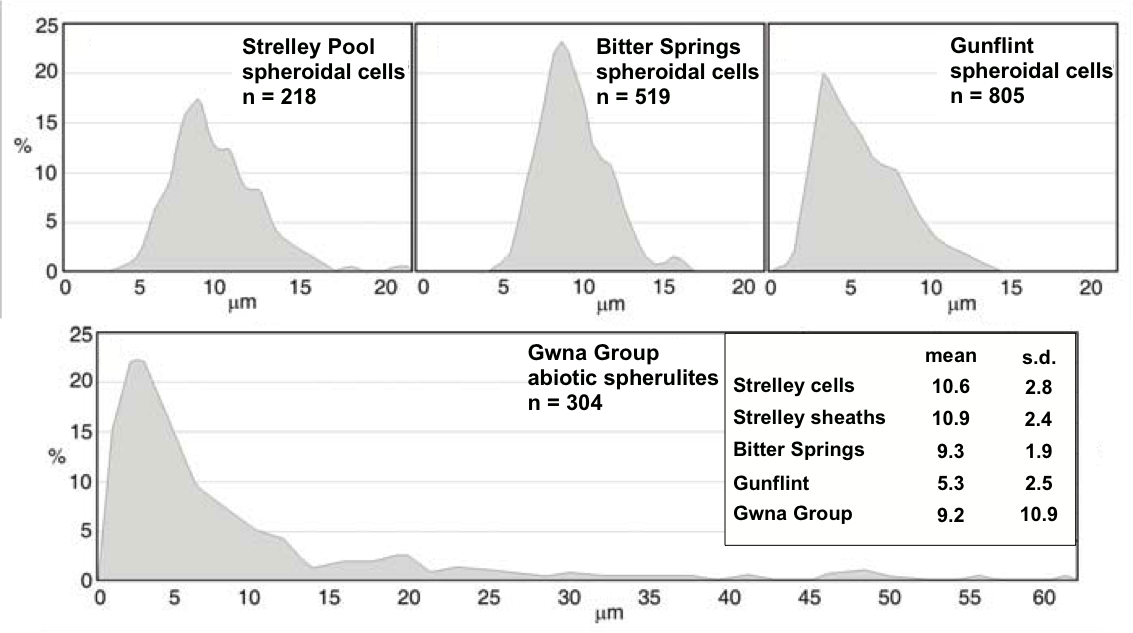
Size distributions of microfossils from the Strelley Pool Sandstone compared to those from three younger biological microfossil assemblages and one abiotic spherulite assemblage. (Wacey et al. 2011).
Also the distribution of sizes is similar to that of other accepted fossil forms in the 1.9 billion year old Gunflint Chert of Ontario and the 0.8 billion year old Bitter Springs formation of Central Australia. These latter fossils are considered to be Prokaryote fossils. However, this does not represent the total distribution.

80 μm giant from Wacey et al. 2011
As Wacey et al. state, and PZ has discussed, there are larger specimens, if rare, up to 80 μm in size (see left), which is much larger that normal. However, prokaryotes do exhibit larger size ranges, so it is not implausible that cells could range up to this size.

Another explanation could be that these large ‘cells’ represent a cluster of cells in which only the outer cell walls in contact with pore fluids have been preserved, while the internal walls dividing individual cells are not preserved. Certainly the structures arrowd in the large specimen could represent the boundaries between cells as much as they could represent folding. The presence of silica micro-crystals in cell walls does suggest that silica-rich pore fluids played a part in the preservation process. So the larger specimens could be the remains of clumps of cells, or possibly a different group of organisms from the smaller ones.

The numerous lines of evidence tends to support the identification of these structures as organic ans potentially prokaryote cells, making them the oldest life forms so far identified.

So why the attraction to sulphur? Well, in the absence of oxygen, SO42- makes a good terminal electron acceptor. Larry Moran has the details.

Given the age, it will probably be impossible to get absolute evidence that any particular set of structures represent Archaen prokaryotes, but the evidence Wacey et al. 2011 present is probably as close as we could reasonably expect to come.

So with these Archaen prokaryotes, and the Ediacaran fauna, when it comes to Precambrian life, AUSTRALIA ROCKS!

Wacey, D., Kilburn1, M.R., Saunders, M., Cliff, J. and Brasier, M.D (2011) Microfossils of sulphur-metabolizing cells in 3.4-billion-year-old rocks of Western Australia. Nature Geoscience. Published online Aug. 21. DOI: 10.1038/NGEO1238

Saturday, August 13, 2011

Palaeoporn 23

Indiana Nedin and the Temple of Kaili


OK, I'm back, after several months of work and travel, which included losing the top of the Eiffel Tower, and finding it again, avoiding an Ebola E-coli outbreak in Hamburg, and retracing the route of The Italian Job in Torino, it's about time I got back to some real work and started posting on the blog again!

Continuing the tradition of famous fossil sites wot I have visited, the photo above (taken a few years ago now) is of me doing my Indiana Jones impression on a hilltop at the site of the Kaili Formation in Guizhou province, southwest China, some 550 kilometres ENE of Kunming and the Changjiang fauna.

The Kaili formation is basal Middle Cambrian in age (see figure at right) and contains the Kaili Biota, a Changjiang/Burgess Shale type lagerstätte. Given it's age, the biota sits midway in age between the Lower Cambrian Changjiang fauna and the Middle Cambrian Burgess Shale fauna.

As would be expected, the Kaili biota shows significant overlap with both the Chengjiang and Burgess faunas in terms on genera in common. Wikipedia, suggests that of the (quite diverse) 110 genera occurring in the Kaili biota, 30 are shared with the Chengjiang fauna, and 40 are shared with the Burgess fauna.

The Kaili biota is thought to represent an outer-shelf environment and contains large numbers of planktonic trilobites, and eocrinoids, along with a range of soft bodied forms such as neroiids, Wiwaxia and Marrella

However, that's not what I want to talk about. See the village to my right in the photo above (click on the photo to enlarge)? That was our way down from the site. That's what I want to talk about because when we entered the village we were greeted with this:


We had entered a village of the Mountain Miao Minority Peoples of Guizhou, and they laid on a traditional welcome ceremony for us. This started with two local girls in full traditional costume offering food and drink to each person as they entered. The traditional dress included amazing jewelry in solid silver! On this occasion we were offered fish and some lethal alcoholic local brew from a ceremonial horn.

Once inside we were treated to a series of traditional dances, again performed by the girls of the village complete with elaborate gorgeous silver jewelry.


We were not informed that this was going to happen so it was a complete surprise. It was an amazing experience, and was the perfect end to the day.


Further Reading

ZHAO Yuanlong, ZHU Maoyan, Loren E. BABCOCK, YUAN Jinliang, Ronald L. PARSLEY, PENG Jin1, YANG Xinglian1, WANG Yue1 (2005) Kaili Biota: A Taphonomic Window on Diversification of Metazoans from the Basal Middle Cambrian: Guizhou, China. Acta Geologica Sinica; 79(6) 751–765. DOI: 10.1111/j.1755-6724.2005.tb00928.x

Saturday, July 16, 2011

Paris June 2011


Good news. The bit of the Eiffel Tower that was missing in February is now back.

Friday, May 20, 2011

Hamburg

Things have been a bit quiet recently because inexplicably, the people who pay me actually want me to do stuff!

Part of that stuff will have me at a loose end in Hamburg on the weekend of 11th and 12th June. So if anyone has any suggestions about things to do in Hamburg, I'd be grateful for some tips.

Meanwhile, normal service will be resumed as soon as possible

Sunday, April 3, 2011

Mopping up some Ediacaran Enigmatics

The most common form of preservation of Ediacaran fossils in the Flinders Ranges of South Australia is by sands covering objects on the sea floor and masking them. Much of the sea floor was covered with algal and bacterial mats, or films, that add an extra dimension to the structures preserved by the covering sands. We have to take this extra dimension into account if we are to successfully interpret what it is that has been preserved. Some organisms lived on the mats, some below, and some had elements below and elements above. Understanding the interactions between organism, mat and sand will allow us to better understand what was going on at the time and help separate out body fossils from trace fossils from non-biogenic traces.

A good example of this are "mops".

"Mops" are a series of abundant, distinct structures which look like the head of a mop - hence the name. "Mops" are always preserved in hyporelief, that is on the underside of the rock, unusually though, they can be either positive - standing up from the surface like a pimple, or negative - a depression in the surface like a dimple. Most Ediacaran fossils are usually either one or the other.

Tarhen et al. studied a series of "mops" which show a highly varied shape and structure, but found some consistent features.

Mop structures in hyporelief from the Ediacaran of South Australia.
Scale bar = 2cm. (Tarhan et al. 2010)

(1) "Mops" are always orientated within 10 degrees of the palaeocurrent as derived from a number lines of evidence.

(2) They have a distinct margin at one end - considered to be the distal or far end. This can be straight (arrowed in (A) above), curved (in (B)) or lumpy (in (C)).

(3) They have a series of roughly parallel lines running at around 90 degrees to the margin (arrowed in (B) above). These appear filament-like and can be either linear or wavy and tangled

These features can vary even within the same bed and between specimens in close proximity.

They do tend to appear in close association with the disc form Aspidella, which it though to represent the holdfast of a Charniodiscus-like organism or sea pen. But are they fossils or non-biogenic marks?

Well they appear biogenic. The association with Aspidella is too strong to be random. But are they body or trace fossil? Well, they are a little of both.

The association with Aspidella appears important. Aspidella is the holdfast of a sea pen-like organism, which had a large bulbous holdfast buried in the sediment, with a stalk and frond rising up into the water column. So the organism has some elements (the holdfast) below the bacterial mat, and some (the frond) above the mat.

In this configuration, the frond will be subject to water currents. What is though to have happened is that strong currents carrying the sand that will eventually overlay the organisms has hit the frond and basically dragged the whole organism including the holdfast, in the direction of the palaeocurrent. As the holdfast is under the mats, this dragging has uprooted the holdfast and dragged it through the microbially bound mat layer. The parallel lines represent torn-up bits of mat which were attached to the top of the holdfast. Lumpy margins of the 'mops' are probably caused by small lumps of sediment trapped next to the holdfast.

Formation of "mops". A: Normal conditions. B: Current drag. C: Current induced structures.
D: Sand deposition. E: Preservation. (Tarhan et al. 2010)

This explanation can explain a number of structures seen in Ediacaran rocks. One in particular is Pseudorhizostomites.

Pseudorhizostomites. Scale bar = 2 cm. (Tarhan et al. 2010).

Pseudorhizostomites has been interpreted as a rhizostomean medusa (a jellyfish without tentacles), and even a gas escape structure formed during the decay of an organism. But an interesting interpretation based on the 'mop' formation, is that they are Aspidella-like holdfasts that have been torn free by current action, but vertically rather than in a more horizontal direction. So they have been plucked out of the sediment rather than being dragged along.

Another structure that appears related is one associated with actual holdfasts.


Here the holdfast has remained intact and in place, but the stem has been flattened and the surface of the holdfast has been distorted by the sheer forces caused by the current pushing the frond and stem over.


Here is an annotated example that has been featured here before. The wrinkles (W) and the impression of the stem (S) are clearly visible and have been caused by the stem and frond being pushed over by a strong current which eventually deposited the overlying sand bed

The explanation of the "mop" structures is a neat use of the interplay between sedimentology and taphonomy, that ties together a number of structures.

Tarhan, L.G., Droser, M.L. and Gelhing, J.G (2010) Taphonomic Controls on Ediacaran Diversity: Uncovering the Holdfast Origin of Morphologically Variable Enigmatic Structures. Palaios V. 25, pp 823-830. DOI:10.2110/palo.2010.p10-074r

Friday, April 1, 2011

New Find Challenges Evolution

I've been a passionate supporter of evolution, but now . . .

A recent find from the Flinders Ranges of South Australia will shake the theory of evolution to the core. But no-one knows about it.

Why?

I've tried to talk to palaeontologists about it, but the refuse to discuss it. Evolutionists I've known for years no longer reply to my emails. I've been ignored buy organising committees for conferences and symposiums in favour of other evolutionists when I have earth shattering evidence against their pet theory.

They may have frozen me out, but I will not be silenced.

From a Precambrian site deep in the Flinders Ranges, I was guides by something . . . or someone, and I found startling remains - reptile remains with clear preservation of skin. How could that be if the 'so called' (in my opinion now) theory of evolution is true? How can exceptionally preserved reptile remains be present at a Precambrian site?

It can't. But it is. So evolution must be false.

Click on the link below and spread the evidence the the evolutionists have tried to stop me from exposing.

Reptiles in the Precambrian disproves evolution

Thursday, February 17, 2011

Paris Feb 2011

Something told me I'd picked the wrong day to check out the view from the top of the Eiffel Tower . . .


Wednesday, February 2, 2011

Palaeoporn 22

Treptichnus pedum


The type section for the Cambrian-Precambrian boundary is at Fortune Head, Burin Peninsula, Newfoundland, as is marked by the first appearance of the trace fossil Treptichnus pedum (the trace fossil formally known as Phycoides pedum).

Treptichnus pedum is a distinctive burrow pattern comprised of a series of lobes set along a central, sometimes curved burrow, thought to represent successive probes into the sediment searching for food. The traces are thought to represent an organism more complex that those of the Ediacaran, but that is not necessarily true, as no actual animal has been found is association with the burrows, so we don't know what made them (although modern priapulid worms make similar burrows).

However, we should not confuse the somewhat complicated pattern of Treptichnus pedum with the first occurrence of well-developed, fairly complex metazoan animals.

While the start of the Cambrian is marked by the first appearance of Treptichnus pedum, this is not the first appearance of trace fossils probably from metazoans. A number of trace fossil types exist in the preceding Ediacaran rocks. In fact they show a neat line in increasing complexity from simple traces early in the Ediacaran to traces as complex as T. pedum towards the end of the Ediacaran.

The earliest traces we have, and the most simple, is Planolites


This is a lowermost Cambrian specimen (picture from NCSE), but it shows you what they are like. The fossil is of simple, cylindrical, unbranched and unlined burrows. They are usually sinuous and undulatory, and often appear as small knobs or discontinuous segments on bedding planes. The small image below is what they typically look like in Ediacaran rocks


Further up in the Ediacaran, more traces appear. This is Helminthopsis


Helminthopsis are much more meandering burrows that appear to represent shallow feeding burrows. the distinctive whorls and loops are considered to represent a different feeding strategy to that of Planolites.

Towards the top of the Ediacaran, things get a bit more complex. As well as Planolites and Helminthopsis, we get the feeding traces of Kimberella.


Here, the feeding traces are marked "R" for radula, and the animal itself is marked "K". A Dickinsonia is also present. "K'" and "D'" mark the resting trace of Kimberella and Dickinsonia, which comprise, of course, another form of trace fossil.

Towards the top of the Ediacaran, things start to get crowded. Not only do we have all the previous traces, but they are joined by Mattaia miettensis.


This specimen comes from the Kessyusa Formation, from Khorbusuonka in northern Siberia. The trace is filled with two bands of sediment, raised on the sides and depressed in the middle, where the bands are separated by a vertical fissure filled with clay. A possible culprit is a pripulid worm such as the Burgess Shale form Louisella pedunculata.

So by the time you get to the Cambrian-Precambrian boundary there were quite a few traces around. Sure in the Cambrian the traces get much more diverse, but they don't start at the boundary, there is a steady increase in trace fossils through the Ediacaran.


Update
Aleksey Nagovitsyn has kindly informed me that the age range for Mattaia miettensis in Palaoeporn 22 is incorrect, and Mattaia miettensis is actually to be found in the Cambrian Tommotian Stage of the Cambrian.

So we need to remove Mattaia miettensis from the list of trace fossils found at the top of the Ediacaran.

Friday, January 14, 2011

"You Cannot Trust Reasons to Believe"

At least that's what Todd Wood thinks.

In a series of detailed posts, Todd does an excellent job of taking apart a series of posts and responses by Dr Fuzale Rana of Reasons to Believe (a christian group that "bridges the gap between science and faith by exploring questions about God and the Bible". They have no problem with an ancient Earth, but evolution is apparently another matter) on the similarity between the human and chimp genome (or not, in the case of Reasons to Believe) and moves on to pseudogenes, thus:
"In his latest post, Rana asserts the following about the argument for common ancestry from pseudogenes:

When evolutionary biologists present this argument, they make a number of assumptions, all of which appear to have questionable validity based on recent research results. For the pseudogene evidence to have potency: (1) pseudogenes must lack function; (2) their origin must be due to rare, random events; and (3) their juxtaposition to other genes must be arbitrary.

Everything he wrote there is utterly false. None of those conditions are required to argue for common ancestry from pseudogene similarity. Not one."
Ouch!

Well, you may say, 'showing up the mangling of science by those seeking to support their religious views, is not unusual".

True. But Todd happens to be a young earth creationist.

Double ouch!

Here is post one, from there move on to "Newer Post" and read them in sequence. Post four is at the bottom of the front page of Todd's blog. You can work your way up.

It's well worth the read.

Sunday, January 9, 2011

Palaeoporn 21

Beltanelliformis brunsae


In keeping with the positive hyporeliefian, is-it-or-isn't-it-a-metazoan theme of the last couple of posts, here is Beltanelliformis brunsae. A widespread form (this one is from the Mackenzie Mountains of Canada) that has had a history of being moved around the tree of life.

Notice firstly the texture of the surface. This is a microbial mat that has undergone some considerable deformation, probably due to the sudden influx of sand which pressed down on the mat and caused it react unevenly to the sudden load.

The Beltanelliformis appear at first glance to be similar to other disc-like Ediacaran forms associated with holdfasts. However, notice that the specimens pictures are in strong positive hyporelief, that is they extend quite some way out from the lower surface of the sandstone. This means that the sand infilled quite a sizable hole in the underlying mud. Notice also that, in the top two specimens, the fossil has a 'collar' around the basal disc, which makes the hole infilled by the sand cone-shaped, with the base being the smaller diameter part of the cone.

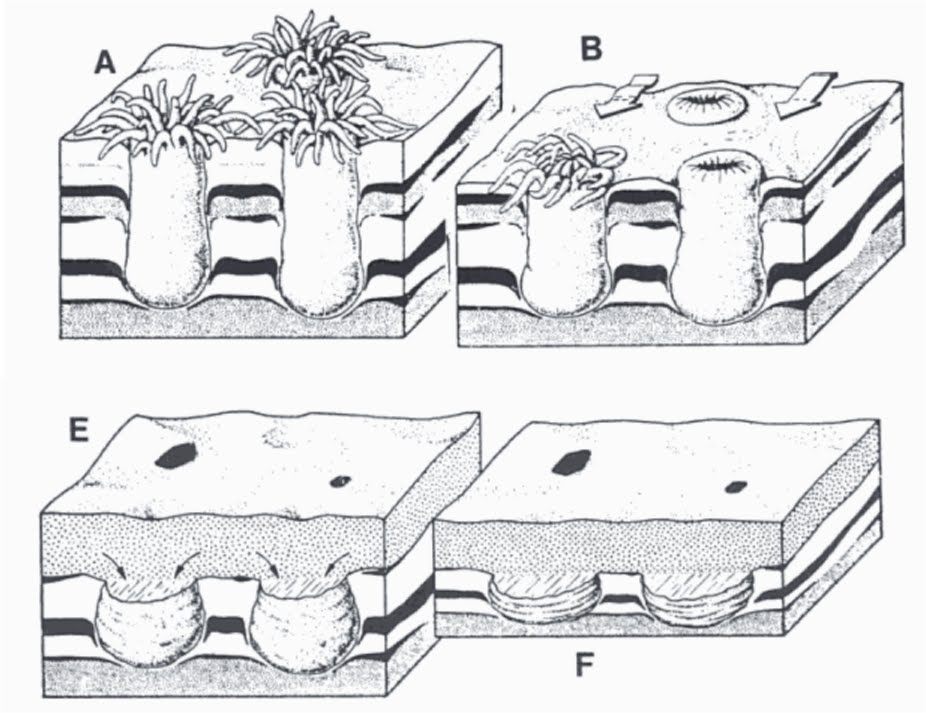
This configuration let to suggestions that the form represents the burrow of an anemone.

Below is a representation of that interpretation (from Schopf et al.).

However, more recent interpretations have Beltanelliformis as an algae.

What!? Algae!?

Yes, algae. Here's why.

The uppermost Doushantuo Formation (590-555 Ma) at Miaohe in the Yangtze Gorges area, is a series of dolomites that provide a rare Burgess-Shale-type taphonomic window on the Ediacaran. Within the Formation are found numerous carbonate compressions of organisms. This represents a different mode of preservation to that of the more typical sandstone preservation, at Miaho the forms are flattened carbonate compressions. Amongst the forms present are several that are interpreted as Beltanelliformis

Beltanelliformis brunsae from the Doushantuo Formation. Scale in 2, 1 cm. from Xiao et al. 2002)
The non-overlapping nature of the fossils is a good indication that we are dealing with benthic (bottom-dwelling) forms and not free-swimming forms that have died and sunk to the bottom. It may well be that the forms were actually tethered to bottom with a small holdfast structure.

The Doushantuo specimens have thing flexible walls. However, given the original specimen at the beginning of this post, it's clear that they would need to retain the three-dimensional shape during burial by sand.

A modern form that appears to fit the bill is the caulerpalean green alga Derbesia (photo credit).


Derbesia is benthic, is attached by a minute holdfast, and has the right shape and size. Also, it is organized as a coenocytic film of cytoplasm within a elastic and strong wall and surrounding one or more large, fluid-filled vacuoles. These vacuoles would be sealed and so couldn't empty on burial like holdfasts could. This makes it strong enough to make an impression in sandstone preservation!

So Beltanelliformis has gone from Cnidarian -> holdfast -> anemone burrow -> algae with holdfast.

Interestingly, apart from Nimbia and Aspidella mentioned in a previous post, Beltanelliformis has one of the longest time ranges, having been found in the pre-Ediacaran Cryogenian in Canada.

This again raised the possibility that several of the generic Ediacaran disc fossils could be something other than metazoans. That's actually fine. We have enough evidence that some of the discs represent metazoans. That some don't, should be expected. After all, if the Ediacaran assemblages represent vibrant, healthy ecosystems, they would be expected to contain microbial, algal, and metazoan, life.