Showing posts with label Palaeontology. Show all posts

Sunday, August 28, 2011

3.4 Billion Year Old Microfossils? . . . Umm Yes (Probably)

Sshhh, be vewy vewy quiet. We’re hunting Awchean pwokawyotes.

There is good carbon and sulphur isotope geochemical evidence that life has existed on Earth from the early Archean. This life is thought to consist of small prokaryote cells with a penchant for sulphur instead of oxygen.

However, identifying actual fossil evidence is very tricky for a number of reasons. One of the major ones being, that given the 3.5 billion year time span and plate tectonics, few rocks from this period of Earth history remain on the surface. Of those that do, most either were unsuitable to preserve life in the first place (e.g. volcanic rocks) or have been metamorphosed until any possible organic trace has been cooked to oblivion.

So, if you want to go hunting Archean microbes you need to look in an area with rocks that have been relatively unmolested for some 3.5 billion years or so.

Presenting the Pilbura Craton, Western Australia. The Craton consists of (relatively) unaltered 3.7-2.6 billion year old rocks formed of a granite–greenstone terrane consisting of a series of dome shaped granitoid bodies, overlain by an extensive sequence of Archaean and later metasediments. Within the Craton, the East Pilbara Terrane contains a suite of approx. 3.4 billion year old sedimentary rocks which occur sandwiched between two suites of volcanic rocks.

This is the Strelley Pool Formation and is thought to be between 3426-3340 million years old. At the base of Formation, sitting unconformably on underlying 3515 million year old basalts, is a remarkably well preserved sandstone. (The ridge in the header image above. The red dots mark the position of the unconformity between the underlying basalts and the Strelley Pool Formation. Image (sans Elmer) from Wacey et al. 2011. Supplementary Information)

The sandstone is dark coloured at the base, due to it being carbonaceous- and pyrite-rich, where it sometimes fills channels eroded into the underlying basalt. Above this, the sandstone becomes lighter as the carbonaceous matter and pyrite disappear, before passing into overlying limestones - which contain possible stromatolites - and cherts.

Thin section photomicrograph showing multiple generations of carbonaceous material and silica cements within the Strelley Pool sandstone. DQ, detrital quartz grains. C1, carbon material, interpreted as a biolfilm, covering quartz grains. S1, first silica cement layer, up to c. 30 μm partially filling the void space between the detrital quartz grains. C2, A second carbon biofilm covering the surface of the S1 silica layer. S2, a second generation of silica cement precipitated in the larger pore spaces. C3, a third generation of carbon biofilm. (Wacey et al. 2011. Supplementary Information).
This fantastic thin section photomicrograph provides a wealth of information that allows us to reconstruct how the sandstone was formed. The grains are well rounded detrital quartz. Grains of detrital pyrite are also present. The grains are covered with a thin film of carbonaceous matter, and show a number of silica cementation events, some of which show a dripstone texture.

A second film of carbonaceous matter covers the primary silica cement layers. The central spaces between grains not occupied by the silica layers and carbon films, is filled with chert.

From this we can say that the well-rounded, large quatrz and pyrite grains suggest the sandstone was deposited in a high energy environment, such as a beach or estuary. The sandstone is also very clean - there is no fine material such as silt or clay - also supporting a high energy environment of deposition which would have washed out all the fine-grained material such as silt and clay.

The several episodes of silica cementation suggests cyclic inundation of silica-rich fluids into porous, clean sands.

Thin section showing b, Rounded quartz grain separated from a carbon-rich chert infilling by a dripstone cement (white arrow). c, Rounded grain of detrital pyrite (black grain) with a dripstone chert cement and carbon coating (red arrow). (Wacey et al. 2011).
The dripstone cements are exactly that, they appear as 'drips' of cement on the bottom on grains. This is because they form when the grains are exposed to air and trapped fluid flows to the bottom of the grains. This supports a beach-type environment which was influenced by valdose conditions - where non-marine groundwater is retained by adhesion to grains or by capillary action.

The evidence suggests then, that the sandstone was deposited in a nearshore beach-type environment which helped smooth out the quatrz and pyrite grains, and removed any fine material. During this time the first layer of carbonaceous material was formed around the grains (C1 above). Periodically, the highly porous sand came under the influence of valdose conditions, allowing the precipitation of silica cement around the grains (S1 above), trapping the carbonaceous layer, but maintaining the porous nature of the sand. Subsequently a second layer of carbonaceous material (C2 above) was formed over the S1 cement, possibly suggestive of a reversion to marine influences. A second round of valdose conditions produced a second cementation layer (S2 above). Followed by another return to marine influences and a third carbonaceous layer (C3 above). Finally, after the sands were buried, subsequent chert deposition provided the source for the last event, the filling of the remaining pore space with chert.

Before we look at the carbonaceous material in more detail there is the question of the link between the detrital pyrite grains and the carbonaceous matter.

The detrital pyrite grains are large, much larger than the possible cells in the carbonaceous matter, and are rounded. This suggests that the pyrite is not a product of possible organic activity. There is some pyrite within the carbonaceous matter, but this pyrite is much smaller and angular in shape - as expected if they have been precipitated as a result of organic activity. The detrital pyrite grains are also covered by the silica cement layers. The evidence suggests that the pyrite is primary - that is it was present as an original constituent of the sand - rather then being a product of organic activity. As the pyrite only occurs in the base of the sandstone, primarily in erosive channels in the underlying volcanics, it seems likely that the pyrite grains were formed from the erosion of underlying rocks and have been left behind as a lag deposit as pyrite grains are much heavier that similar sized grains formed from other materials like quartz. The renewed influx of sediment resulted in the pyrite grains mixing with the quartz grains to form a pyrite-rich basal sand. Subsequent deposts of sand did not have the pyrite grains and so were deposited free of pyrite and carbonaceous matter. Remember also that the 3.4 Bya atmosphere has precious little in the way of free oxygen, so the pyrite would be quite stable under surface conditions.

Since the detrital pyrite and carbonaceous matter are absent from the sandstone above the basal layer, there does appear to be a connection between the detrital pyrite and the carbonaceous matter. It appears that the carbonaceous matter is present because of the pyrite.

To answer why the carbonaceous matter should be linked to the pyrite, we first need to know what the carbonaceous matter is and what it contains.

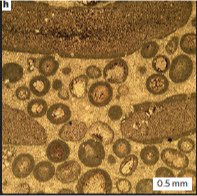
Wacey et al. have found a number of elements (at right) in the carbonaceous film that look like prokaryote cells (or at least what prokaryote cells would look like after 3.4 billion years). So the question is, are we dealing with 3.4 billion year old microfossils?

Ramen spectroscopy (it's to do with lasers and nothing to do with Arthur C. Clarke) supports a disordered structure. This is important because organic matter is disordered, inorganic carbonaceous matter is ordered - abiotic graphite, for example, is found in rocks of this age but shows a well ordered internal structure. So that's a tick for organic. Also, an analysis of the structures indicates the presence of carbon, nitrogen and sulphur in the possible cell wall structures. Again a tick for organic as these are essential for organically formed structures, but not for inorganic ones.. Finally analysis of the carbon in the possible cell walls shows a 26-39 parts per thousand enrichment in 12C compared with atmospheric CO2. This also support the structures being organic as only organic activity can partition light 12C from the 'heavier' 13C to such an extent.

So the evidence suggests that the structures are organic, but are they microfossils?

Well, the shapes are round and tube-shaped. So, as prokaryotes tend to be round and tube-shaped, this is a good thing. However, a number of inorganic processes can produce round and tube shapes. So, by itself, this doesn’t tell us much. The specimens do show some evidence of folding, which organic shapes would do that inorganically produced shapes wouldn’t. So shape is a point in favour of them being microfossils, but not conclusive.

Size is an interesting one. Prokaryotes come in a range of sizes, but modern forms are generally around the 10 μm mark. The forms found range in size from 5-25 μm, with an average size of around 10 μm, not a bad comparison with modern forms.
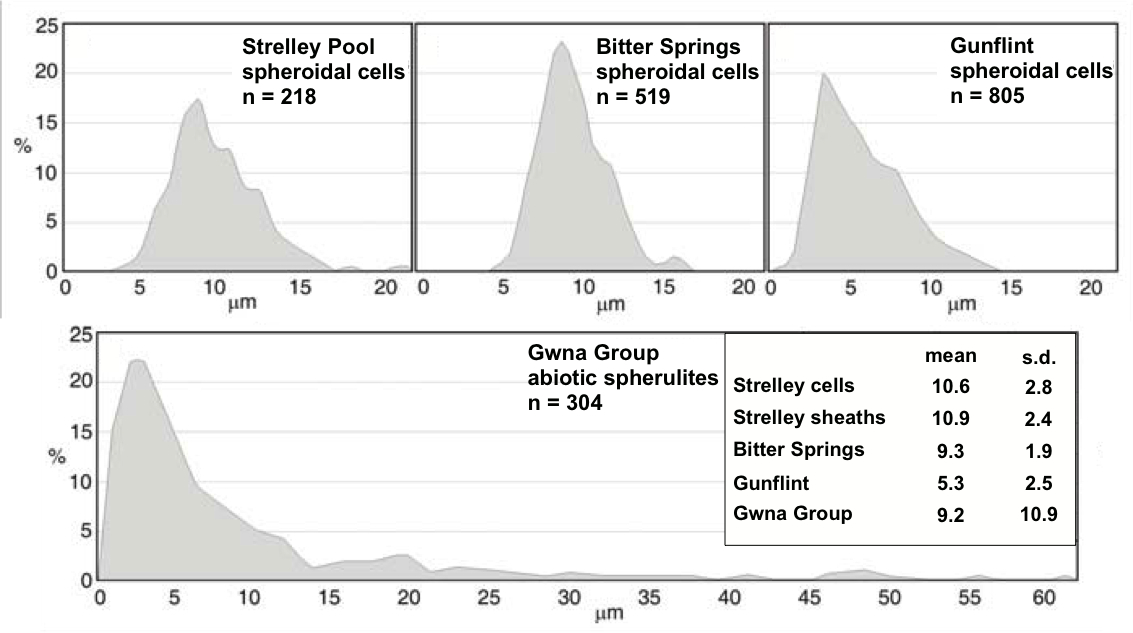
Size distributions of microfossils from the Strelley Pool Sandstone compared to those from three younger biological microfossil assemblages and one abiotic spherulite assemblage. (Wacey et al. 2011).
Also the distribution of sizes is similar to that of other accepted fossil forms in the 1.9 billion year old Gunflint Chert of Ontario and the 0.8 billion year old Bitter Springs formation of Central Australia. These latter fossils are considered to be Prokaryote fossils. However, this does not represent the total distribution.

80 μm giant from Wacey et al. 2011
As Wacey et al. state, and PZ has discussed, there are larger specimens, if rare, up to 80 μm in size (see left), which is much larger that normal. However, prokaryotes do exhibit larger size ranges, so it is not implausible that cells could range up to this size.

Another explanation could be that these large ‘cells’ represent a cluster of cells in which only the outer cell walls in contact with pore fluids have been preserved, while the internal walls dividing individual cells are not preserved. Certainly the structures arrowd in the large specimen could represent the boundaries between cells as much as they could represent folding. The presence of silica micro-crystals in cell walls does suggest that silica-rich pore fluids played a part in the preservation process. So the larger specimens could be the remains of clumps of cells, or possibly a different group of organisms from the smaller ones.

The numerous lines of evidence tends to support the identification of these structures as organic ans potentially prokaryote cells, making them the oldest life forms so far identified.

So why the attraction to sulphur? Well, in the absence of oxygen, SO42- makes a good terminal electron acceptor. Larry Moran has the details.

Given the age, it will probably be impossible to get absolute evidence that any particular set of structures represent Archaen prokaryotes, but the evidence Wacey et al. 2011 present is probably as close as we could reasonably expect to come.

So with these Archaen prokaryotes, and the Ediacaran fauna, when it comes to Precambrian life, AUSTRALIA ROCKS!

Wacey, D., Kilburn1, M.R., Saunders, M., Cliff, J. and Brasier, M.D (2011) Microfossils of sulphur-metabolizing cells in 3.4-billion-year-old rocks of Western Australia. Nature Geoscience. Published online Aug. 21. DOI: 10.1038/NGEO1238

Sunday, April 3, 2011

Mopping up some Ediacaran Enigmatics

The most common form of preservation of Ediacaran fossils in the Flinders Ranges of South Australia is by sands covering objects on the sea floor and masking them. Much of the sea floor was covered with algal and bacterial mats, or films, that add an extra dimension to the structures preserved by the covering sands. We have to take this extra dimension into account if we are to successfully interpret what it is that has been preserved. Some organisms lived on the mats, some below, and some had elements below and elements above. Understanding the interactions between organism, mat and sand will allow us to better understand what was going on at the time and help separate out body fossils from trace fossils from non-biogenic traces.

A good example of this are "mops".

"Mops" are a series of abundant, distinct structures which look like the head of a mop - hence the name. "Mops" are always preserved in hyporelief, that is on the underside of the rock, unusually though, they can be either positive - standing up from the surface like a pimple, or negative - a depression in the surface like a dimple. Most Ediacaran fossils are usually either one or the other.

Tarhen et al. studied a series of "mops" which show a highly varied shape and structure, but found some consistent features.

Mop structures in hyporelief from the Ediacaran of South Australia.
Scale bar = 2cm. (Tarhan et al. 2010)

(1) "Mops" are always orientated within 10 degrees of the palaeocurrent as derived from a number lines of evidence.

(2) They have a distinct margin at one end - considered to be the distal or far end. This can be straight (arrowed in (A) above), curved (in (B)) or lumpy (in (C)).

(3) They have a series of roughly parallel lines running at around 90 degrees to the margin (arrowed in (B) above). These appear filament-like and can be either linear or wavy and tangled

These features can vary even within the same bed and between specimens in close proximity.

They do tend to appear in close association with the disc form Aspidella, which it though to represent the holdfast of a Charniodiscus-like organism or sea pen. But are they fossils or non-biogenic marks?

Well they appear biogenic. The association with Aspidella is too strong to be random. But are they body or trace fossil? Well, they are a little of both.

The association with Aspidella appears important. Aspidella is the holdfast of a sea pen-like organism, which had a large bulbous holdfast buried in the sediment, with a stalk and frond rising up into the water column. So the organism has some elements (the holdfast) below the bacterial mat, and some (the frond) above the mat.

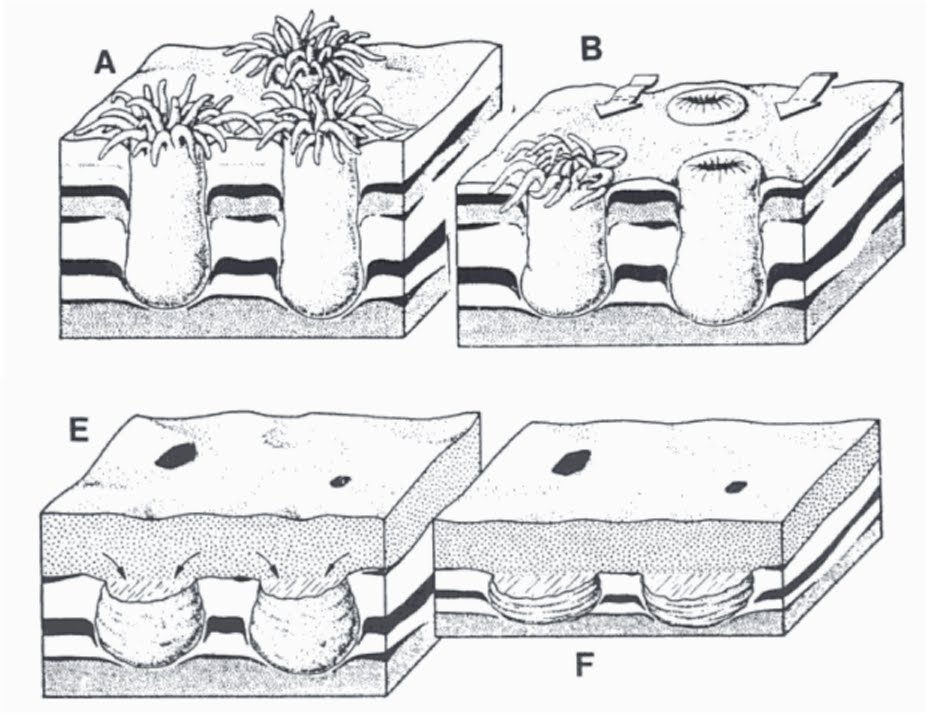
In this configuration, the frond will be subject to water currents. What is though to have happened is that strong currents carrying the sand that will eventually overlay the organisms has hit the frond and basically dragged the whole organism including the holdfast, in the direction of the palaeocurrent. As the holdfast is under the mats, this dragging has uprooted the holdfast and dragged it through the microbially bound mat layer. The parallel lines represent torn-up bits of mat which were attached to the top of the holdfast. Lumpy margins of the 'mops' are probably caused by small lumps of sediment trapped next to the holdfast.

Formation of "mops". A: Normal conditions. B: Current drag. C: Current induced structures.
D: Sand deposition. E: Preservation. (Tarhan et al. 2010)

This explanation can explain a number of structures seen in Ediacaran rocks. One in particular is Pseudorhizostomites.

Pseudorhizostomites. Scale bar = 2 cm. (Tarhan et al. 2010).

Pseudorhizostomites has been interpreted as a rhizostomean medusa (a jellyfish without tentacles), and even a gas escape structure formed during the decay of an organism. But an interesting interpretation based on the 'mop' formation, is that they are Aspidella-like holdfasts that have been torn free by current action, but vertically rather than in a more horizontal direction. So they have been plucked out of the sediment rather than being dragged along.

Another structure that appears related is one associated with actual holdfasts.


Here the holdfast has remained intact and in place, but the stem has been flattened and the surface of the holdfast has been distorted by the sheer forces caused by the current pushing the frond and stem over.


Here is an annotated example that has been featured here before. The wrinkles (W) and the impression of the stem (S) are clearly visible and have been caused by the stem and frond being pushed over by a strong current which eventually deposited the overlying sand bed

The explanation of the "mop" structures is a neat use of the interplay between sedimentology and taphonomy, that ties together a number of structures.

Tarhan, L.G., Droser, M.L. and Gelhing, J.G (2010) Taphonomic Controls on Ediacaran Diversity: Uncovering the Holdfast Origin of Morphologically Variable Enigmatic Structures. Palaios V. 25, pp 823-830. DOI:10.2110/palo.2010.p10-074r

Sunday, January 9, 2011

Palaeoporn 21

Beltanelliformis brunsae


In keeping with the positive hyporeliefian, is-it-or-isn't-it-a-metazoan theme of the last couple of posts, here is Beltanelliformis brunsae. A widespread form (this one is from the Mackenzie Mountains of Canada) that has had a history of being moved around the tree of life.

Notice firstly the texture of the surface. This is a microbial mat that has undergone some considerable deformation, probably due to the sudden influx of sand which pressed down on the mat and caused it react unevenly to the sudden load.

The Beltanelliformis appear at first glance to be similar to other disc-like Ediacaran forms associated with holdfasts. However, notice that the specimens pictures are in strong positive hyporelief, that is they extend quite some way out from the lower surface of the sandstone. This means that the sand infilled quite a sizable hole in the underlying mud. Notice also that, in the top two specimens, the fossil has a 'collar' around the basal disc, which makes the hole infilled by the sand cone-shaped, with the base being the smaller diameter part of the cone.

This configuration let to suggestions that the form represents the burrow of an anemone.

Below is a representation of that interpretation (from Schopf et al.).

However, more recent interpretations have Beltanelliformis as an algae.

What!? Algae!?

Yes, algae. Here's why.

The uppermost Doushantuo Formation (590-555 Ma) at Miaohe in the Yangtze Gorges area, is a series of dolomites that provide a rare Burgess-Shale-type taphonomic window on the Ediacaran. Within the Formation are found numerous carbonate compressions of organisms. This represents a different mode of preservation to that of the more typical sandstone preservation, at Miaho the forms are flattened carbonate compressions. Amongst the forms present are several that are interpreted as Beltanelliformis

Beltanelliformis brunsae from the Doushantuo Formation. Scale in 2, 1 cm. from Xiao et al. 2002)
The non-overlapping nature of the fossils is a good indication that we are dealing with benthic (bottom-dwelling) forms and not free-swimming forms that have died and sunk to the bottom. It may well be that the forms were actually tethered to bottom with a small holdfast structure.

The Doushantuo specimens have thing flexible walls. However, given the original specimen at the beginning of this post, it's clear that they would need to retain the three-dimensional shape during burial by sand.

A modern form that appears to fit the bill is the caulerpalean green alga Derbesia (photo credit).


Derbesia is benthic, is attached by a minute holdfast, and has the right shape and size. Also, it is organized as a coenocytic film of cytoplasm within a elastic and strong wall and surrounding one or more large, fluid-filled vacuoles. These vacuoles would be sealed and so couldn't empty on burial like holdfasts could. This makes it strong enough to make an impression in sandstone preservation!

So Beltanelliformis has gone from Cnidarian -> holdfast -> anemone burrow -> algae with holdfast.

Interestingly, apart from Nimbia and Aspidella mentioned in a previous post, Beltanelliformis has one of the longest time ranges, having been found in the pre-Ediacaran Cryogenian in Canada.

This again raised the possibility that several of the generic Ediacaran disc fossils could be something other than metazoans. That's actually fine. We have enough evidence that some of the discs represent metazoans. That some don't, should be expected. After all, if the Ediacaran assemblages represent vibrant, healthy ecosystems, they would be expected to contain microbial, algal, and metazoan, life.

Monday, January 3, 2011

To Epirelief or Hyporelief, That is the Question . . .

My last post on the possible 770 million year old Ediacaran fossils from Kazakhstan prompted some comments regarding epi- and hyporelief (go read the post and comments).

Basically, Ediacaran fossils are usually found on the underside of the sandstone bed in either positive relief (sticking out from the surface) or negative (sunk into the surface) hyporelief (hypo- is sciencey for 'on the underside'). This is dictated by the mode of preservation (again see the original post), and means that we do not find them on the top surface of the sandstone bed, or in epirelief. (Actually we do find them in epirelief, but only at Mistaken Point in Newfoundland where they have been mantled by volcanic ash - but that appears to be a one off and so does not represent normal preservation).

As an example here is a slab I collected from the Flinders Ranges in South Australia. First the upper (epi) surface.


As you can see, its rippled - strongly rippled actually - which puts pay to the ideas that the Ediacaran faunas were deep water, but that's another story. However, what the top surface isn't, is fossiliferous. There are no fossils on it.

Now lets take a look at what's underneath.


Ta Da! This was taken in situ, about 5 minutes after I'd found it. The photo is a bit blurry 'cos my hands were stili shaking!

Notice the smooth lower surface. This is because it is mantling a mud which does not form ripples. Also notice that there are three large discs in positive hyporelief and a Dickinsonia in negative hyporelief. What do you mean no!?. Ok, here's an annotated version.


The question has been asked why the counterpart of a positive hyporelief isn't a negative epirelief on the bed below. In other words if the fossil is formed by sand flowing into a depression in the underlying mud to form a positive hyporelief, should there also be a corresponding negative epirelief on the top of the underlying bed?

The answer is yes, but we almost never find them. The reason is that the underlying bed is made of mud and so compresses during diagenesis which disrupts the fossil. However, the main reason is that the mudstone weathers much more readily than the sandstone and forms a very friable, crumbly rock that simply weathers away.

We do have some examples of underlying epirelief fossils, but they are very rare. To find them you have to excavate the sandstone with the underlying mudstone still in place. Even then, they are very fragile. Normally this never happens in nature as the mudstone erodes away. The fossiliferous sandstone then weathers out and falls downslope to be found by palaeontologists.

Below is a typical Ediacaran location. The fossils are eroding off the top of the hill and can just be seen in outcrop. but the fossils are found on the scree slope, as float - that is, material that has eroded out of the outcrop and has slid downslope


So the answer is, yes there are there epirelief fossils but we almost never find them as they have weathered away. But they would be in mudstones and not in sandstones.

Sunday, January 2, 2011

770Ma Ediacara (?) Fossils from Kazakhstan (sadly no)

ResearchBlogging.orgThe Ediacaran Period represents that youngest part of the Proterozoic, and is famous for the first appearance of multicellular, metazoan fossils. The Period starts at the end of the great neoProterozoic Cryogenian, or glaciations - commonly called "Snowball Earth" - at around 635 million years ago, and ends at the start of the Cambrian (and Phanerozoic) at around 542 million yeras ago. While a few Ediacaran stragglers may appear in the Lower Cambrian, no unambiguous multicellular/metazoan fossils have been found below the base of the Ediacaran Period, despite several possible candidates (e.g here and here).

In a new paper, Meert et al. report the possible occurrence of Ediacaran fossils from 760-770 million year old Cryogenian rocks of Kazakhstan. If correct, this would extend the fossil record of metazoans back another 100 million years. Now, there is some evidence to suggest that metazoans were around in the Cryogenian, if only at the sponge-grade of organisation, but this is from biochemistry, not body fossils. So this would be the oldest metazoan body fossils yet found.

Two questions to be asked then. Are these deposits c. 770 million years old? Are these specimens examples of Ediacaran fossils?

I think the answer to the first question is yes, and the answer to the second question is no. I'll explain below.

Age
I have to say that Meert et al. have done an excellent job of mapping and correlating what appears to be a very difficult sequence. It's condensed and so quite thin (by contrast, the Ediacaran type section in Australia is several kilometres thick), a significant portion missing, and the area has been subsequently affected by tectonics.

Stratigraphic column for the Lesser Karatau sequence showing the relative locations of the fossil discoveries. The fossils under discussion are from the Upper Riphean Kurgan Formation (R3) (in brown) and the glacial deposits (in yellow) and cap carbonate represents the end of the Cryogenian glacial episode and the start of the Ediacaran Period. (Meert et al. 2010)
Now with a section like this it could be argued that the glacial rocks and cap carbonate represent glacial activity known to occur in the Ediacaran and that the underlying rocks are, in fact, Ediacaran. But I think Meert et al. have compiled enough evidence to support their stratigraphy. This includes radiometic dating of two separate samples from the Kurgan Formation that support a c. 770 million year age, as well as a δ13C stable isotopic curve that fits their interpretation (given the fragmentary nature of the curve, it could fit a number of scenarios, but it does fit this one.)

So notwithstanding the difficulties of the section, the date appears well supported. We appear to be dealing with c. 770 million year old rocks.

Fossils
1) Disc and stalk
Meert et al. have found structures in the c. 770 million year old Kergan Formation which they suggest may be referable to the Ediacaran forms Nimbia and Aspidella, as well as a second line of evidence, a possible stem extension emanating from the discoid fossil, and ask the question, are these Ediacaran fossils? As I said, I think the answer is no.

To show why, firstly I need to explain a bit about Ediacaran fossil preservation and positive/negative epi/hyporelief.

Ediacaran fossils occur primarily as marking on the surface of sandstones. These surface markings can be of two types, positive - standing up from the surface like a pimple, or negative - a depression in the surface like a dimple. Also the sandstone has two surfaces, a top surface - the epi-, and a lower surface - the hypo. Thus when we talk about surface structure, or "relief" - we talk of structure on the top bedding surface - epirelief, and structure on the lower bedding surface - hyporelief. So positive epirelief is a raised area on the top surface and negative hyporelief is a depression in the lower surface.

This is important because Ediacaran fossils occur as positive or negative relief on the bedding surfaces, but almost always as positive or negative hyporelief - that is, on the bottom surface.

The reason for this is that preservation is by sand covering a surface that has animals on it. The sand (which will eventually turn into sandstone) covers the animals. Where the animal is tough, it will push into the overlying sand, causing a negative hyporelief impression (of the top surface of the animal) into the bottom surface of the sand. Where the animal is buried in the underlying sediment, such as holdfasts, the sand flows into the depression caused by the collapse of the holdfast during burial, causing a positive hyporelief impression.


The example above is of the lower surface, The Form D projects out from the surface and so is a positive hyporelief impression (the overlying sand has pushed down into the Form D stolon structure to form the impression. By contrast, the Parvancorina has pushed up into the overlying sand and so is preserved as a negative hyporelief impression.

OK, lets deal with the second line of evidence first - the possible stem extension emanating from a possible discoid fossil.

(A) Discoidal impression (negative relief) with possible stem-like extension. (B) Sketch showing the location of discoidal fossil and possible stem. Meert et al. 2010.
Just to be clear about what is being discussed, here (at left) is a modern sea pen (photo credit) we can use as an example of the frondose forms around in the Ediacaran. The structure half-buried in the sediment is the disc-shaped holdfast. Underneath the holdfast is a thin tube - the peduncle - which acts like the foot of a clam and aids in digging the organism into the sediment. The stem and frond extend out into the water column and the whole thing is held up by water pressure. The organism can inflate by pumping water into the holdfast to allow it to act as an anchor, and also into the stem and frond to hold them rigid. Pumping water out deflates the organism. Modern sea pens will deflate on touching, and collapse down onto the sediment, as a method to avoid predation or damage.

According to Meert et al., their find may represent a holdfast and part of the attached stem that has made an impression in the sediment, in negative relief. The authors do not say if the surface is the top or bottom (and they may not know if the sample was collected loose and not found in situ.

However, holdfast impressions are almost always found as positive hyporelief impressions, i.e. they stick out from the lower surface. They are not found as negative relief, i.e. as depressions, as the Kurgan Formation specimen is. To find out why that is, let's look at an example.

Three-dimensional positive hyporelief fossil of a holdfast and stem from the Ediacaran of South Australia. HF impression of holdfast, IS intermediary surface within the sandstone, LS lower surface of sandstone, P peduncle, S impression of stem, W wrinkles in top surface of holdfast. White arrow is the direction of current depositing the sand.
Above is an actual Ediacaran holdfast and stem fossil. There's a lot going on here (compared with the Meert et al. specimen where no structure is present) so it'll take a bit of explaining.

Firstly observe that this is in positive hyporelief - it's on the bottom surface of the bed. As I said, pretty much all holdfast fossils with stems are positive hyporelief. This is because the organism is sitting in the underlying sediment and gets inundated and covered by a mantling sand deposit which will become the overlying sandstone bed. Since frondose forms will deflate on contact with the enveloping sandstone, the organism pumps out water and collapses. This means that the stem falls over, usually in the direction of sand transport. The stem often gets trapped within the sand and rarely comes to rest on the sea floor because the sand has started to deposit as the organism responds. This normally results in the stem coming to rest at an shallow angle to the sea floor/base of the sand body - that is, it sticks up at an angle into the sand rather than laying down flat. This can be seen in the Ediacaran example shown above. The stem impression (S) can be seen heading off at the ten o'clock direction but it is obviously heading off into the sandstone - the edge of the stem impression is lower in the sandstone than the impression of the holdfast, and, as this specimen is shown upside down, the stem in heading upwards into the overlying sandstone.

The wrinkling texture is the upper surface of the holdfast reacting to the stem being pushed over and collapsing and shows that the holdfast stayed in place during burial.

The organism is now covered by a layer of sand, with the stem trapped within the sand at a shallow angle. As the water has been pumped out, the holdfast will no longer stay inflated and so the holdfast upper surface sinks down onto the lower surface causing a shallow depression. The upper surface also takes on the shape of the lower surface where the hollow peduncle is, creating a ring shape (P). The overlying sand then flows into the shallow depression and takes on the shape of the combined lower and upper holdfast surface structures in a process called gravity casting. Also, as the stem is angled upwards, the sand with collect behind it and be trapped between the stem and the holdfast. We can see this is the example above. The sandstone covering the stem has been removed, leaving a lighter coloured sandstone. The stem starts out on top of the holdfast, but ends up on a lower, intermediate surface (IS) (lower from our prespective, higher when the specimen is rotated to the correct orientation).

What you end up with is a positive hyporelief impression of the combined upper and lower holdfast surface, plus the base of the stem. Furthermore, this is the only way this can be preserved. We tend not to see holdfast impressions on the tops of sandstones because the organisms appeared to favour softer, finer sediments such as silts and clays, and where active microbial mats occur.

With that in mind lets look at the Meert et al. specimen again.


This time I've annotated it to mark out the various levels in the specimen, with A the highest, B an intermediary level, and C the lowest (assuming we are looking at the top surface, or the reverse if we are looking at the lower surface).

First of all, this is a negative relief. As I explained above, holdfast and stem preservation is usually by gravity casting which produces positive relief. If we are looking at a bottom surface, maybe the organism remained intact and 'pumped up', forming a hollow in the overlying sand. But in that case the stem would also remain intact and we wouldn't see the impression of the stem in the resultant fossil. So if the stem is represented, then the organism had collapsed, in which case the holdfast would have collapsed and we would get a positive hyporelief as notmal.

The structure can't be a positive hyporelief that has eroded out the produce the depression because the original fossil is just a surface impression. The sandstone underneath the fossil is the same sandstone the rest of the rock and so there can be no preferential weathering to produce the hollow.

If we are looking at a top surface, then it is unlikely to be a holdfast and stem as we do not find them on top surfaces of sandstones. Even if it were, the stem appears to have been pushed into the sand body to a level equal to, or even greater than, the depth of the holdfast. Again an unlikely occurrence, as a slight impression on the underlying sand is the most you are likely to get.

Given that this is a negative relief and the lack of any distinguishing structure, it is most likely that the specimen is simply an erosional feature and not a fossil.

2)Nimbia and Aspidella
Specimens referable to Nimbia and Aspidella are reported from the c. 770 millio year old Kurgan Formation.
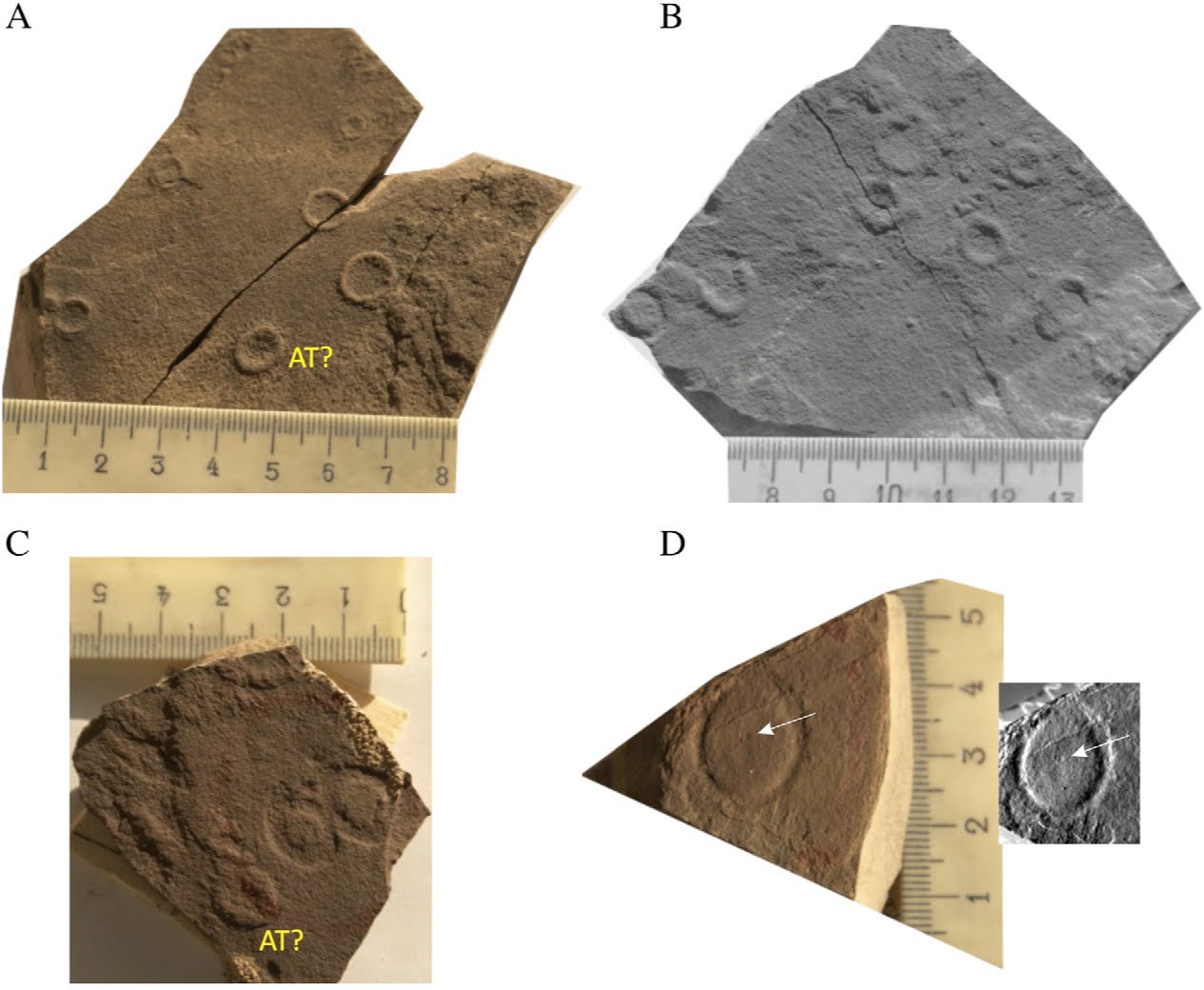
Our specimens were discovered in a brown-red shale within the largely siliclastic Kurgan Formation and are preserved in both hypo and epi-relief. They are circular to oval-shaped impressions that surround either a smooth interior or circular to oval indentations with a smooth interior. (Meert et al. 2010.)
(A) closeup of the Nimbia fossils in positive epirelief, AT marks the occurrence of a possible invaginate morph of Aspidella terranovica; (B) B&W photo of Nimbia impressions shown mostly in positive epirelief; (C) Nimbia fossils in negative relief with a possible invaginate morph of Aspidella terranovica in positive relief; (D) large c. 2 cm (long axis) c. 1.5 cm (short axis) negative hyporelief impression of Nimbia occlusa and an ‘inversion’ of the photo the fossil might appear in positive epirelief. White arrow points to a possible raised central nodule observed in Nimbia occlusa fossils elsewhere. Meert et al. 2010.
Taking Aspidella first. Actually, attributing the form to Aspidella doesn't tell us much. This is because Aspidella should now be considered a form genus - that is a grouping of similar forms (i.e. discs) and not representative of a single organism, or related group of organisms. In other words, a lot of different things make disc impressions, e.g. algae (algal biscuits), microbial colonies, fungae and metazoans. Calling the specimen Aspidella simply says that it is a certain kind of disc, not that it is the Ediacaran form Aspidella terranovica. There are a lot of morphologies within the Aspidella group and they are not produced by the same organism, or even closely related organisms. This means that more than one organism is included under Aspidella. Even worse, no consistent distinction can be made between the various disk structures, making it difficult to accurately assign a particular disc to a particular organism. Where other evidence exists, i.e. stem impressions, ornamentation, etc, it is possible to identify individual organisms or groups of organisms. But simple discs remain probematic. Being a disc does not make it a holdfast!

It is entirely likely that Aspidella actually represents a group of diverse, not closely related, organisms - microbial, algal, fungal and metazoan - that produce discs and overlap each other to give Aspidella a large time range, but this time range is not for a single species or even genus.

This boils down to the fact that Aspidella with stems or other ornamentation, and associated with other Ediacaran forms, can be considered a metazoan fossil. Other Aspidella with no other ornamentation, and not associated with Ediacaran forms, could be anything.

The Nimbia find is in a similar situation. Do we have Nimbia? Yes. But here also, I think that the form Nimbia, like Aspidella, may hide a multitude of sins, or at the very least a number of different organisms. Except I think we have proof here that Nimbia is not an Ediacaran metazoan - or at least this Nimbia is not an Ediacaran metazoan.

The specimens of Nimbia from the Kurgan Formation are found as positive epirelief, negative epirelief, and negative hyporelief. This does not happen for Ediacaran fossils, as discussed above. Since these Nimbia show a number of modes of preservation, and they all show the same structure regardless of mode of preservation, it is apparent that the form that produced it is rigid. It has to be if it produced the same shape whether on the top surface creating a positive or negative imprints, or on the bottom surface. The fossil is the same independent of preservational style, and so whatever is causing the fossil must therefore be rigid like a coin. That rigidity, and the various preservational styles, means that it cannot be a holdfast.

It has been suggested that Nimbia represents microbial colonies. Hard, well agglutinated disk-shaped colonies would be tough enough to cause the impressions, and some have been known to develop a central nodule similar to that found in some Nimbia. This would explain the similar shape through different modes of preservation, and the large time range of the form.

Finally, Ediacaran fossils are normally found as assemblages, with a number of different forms present. The Kurgan Formation specimens are of one main type, Nimbia, and a few Aspidella. Too restricted to be considered an assemblage (a random collection would be expected to uncover more than two forms if an assemblage was present). Even if this find represented an early stage in the evolution of metazoa, it would be expected that more than two forms would be present.

So, discoial fossil with stem? - no. Aspidella? - yes, possibly, but that doesn't mean it's an Ediacaran or even metazoan. Nimbia? - yes, but probably not metazoan.

In properly posing questions about their finds instead of making pronouncements, and suggesting a number of possible interpretations for their finds, Meert at al. have highlighted the important implication of their finds.
It is possible that our discovery of Nimbia occlusa and Aspidella terranovica(?) in sedimentary rocks during the early Cryogenian (N766 Ma) lends support the alternative hypotheses regarding these fossils and remove them from consideration as true metazoa(Meert et al. 2010.)
I think they are right, they have provided evidence that the forms are not metazoan - or at least not "Ediacaran" (as in found amongst Ediacaran assemblages) - fossils, and that the simple disc-shaped forms found in the Proterozoic comprise a form group with contributions from a number of metazoan and non-metazoan sources.


Meert, J., Gibsher, A., Levashova, N., Grice, W., Kamenov, G., & Ryabinin, A. (2010). Glaciation and ~770Ma Ediacara (?) Fossils from the Lesser Karatau Microcontinent, Kazakhstan Gondwana Research DOI: 10.1016/j.gr.2010.11.008


Further reading on Ediacaran discs

Gehling, J.G., Narbonne, G.M., and Anderson, M.M (2000) The first named ediacaran body fossil Aspidella terranovica. Palaeontology, 43: 427-456. DOI: 10.1111/j.0031-0239.2000.00134.x

MacGabhann, B.A. (2007) Discoidal fossils of the Ediacaran biota: a review of current understanding. Geological Society, London, Special Publication, 286: 297-313. DOI: 10.1144/SP286.21

Wednesday, December 29, 2010

The Palaeontological Twelve Days of Christmas - Day 12

Following on from the Twelve Geology Days of Christmas, this year we have a palaeontological version.
On the twelfth day of Christmas my true love sent to me, twelve insects in Australian amber entombing,
eleven ediacaran organisms evolving,
ten tiny T. rex tyrranizing,
nine Nigersaurus nibbling,
eight evolutionary digits encroaching,
seven seismosaurus stomping,
six snakes aslithering,

fiiiiive fossilllll fishhhhhhh,

four fossil footprints following,
three Tribrachidium tripartiting
two trilobites tasting,

and a Cambrian Lagerstätte.

Tuesday, December 28, 2010

The Palaeontological Twelve Days of Christmas - Day 11

Following on from the Twelve Geology Days of Christmas, this year we have a palaeontological version.
On the eleventh day of Christmas my true love sent to me, eleven ediacaran organisms evolving,
ten tiny T. rex tyrranizing,
nine Nigersaurus nibbling,
eight evolutionary digits encroaching,
seven seismosaurus stomping,
six snakes aslithering,

fiiiiive fossilllll fishhhhhhh,

four fossil footprints following,
three Tribrachidium tripartiting
two trilobites tasting,

and a Cambrian Lagerstätte.

Monday, December 27, 2010

The Palaeontological Twelve days of Christmas - Day 10

Following on from the Twelve Geology Days of Christmas, this year we have a palaeontological version.
On the tenth day of Christmas my true love sent to me, ten tiny T. rex tyrranizing,
nine Nigersaurus nibbling,
eight evolutionary digits encroaching,
seven seismosaurus stomping,
six snakes aslithering,

fiiiiive fossilllll fishhhhhhh,

four fossil footprints following,
three Tribrachidium tripartiting
two trilobites tasting,

and a Cambrian Lagerstätte.

Sunday, December 26, 2010

The Palaeontological Twelve Days of Christmas - Day 9

Following on from the Twelve Geology Days of Christmas, this year we have a palaeontological version.
On the ninth day of Christmas my true love sent to me, nine Nigersaurus nibbling,
eight evolutionary digits encroaching,
seven seismosaurus stomping,
six snakes aslithering,

fiiiiive fossilllll fishhhhhhh,

four fossil footprints following,
three Tribrachidium tripartiting
two trilobites tasting,

and a Cambrian Lagerstätte.

Saturday, December 25, 2010

The Palaeontological Twelve Days of Christmas - Day 8

Following on from the Twelve Geology Days of Christmas, this year we have a palaeontological version.
On the eighth day of Christmas my true love sent to me, eight evolutionary digits encroaching,
seven seismosaurus stomping,
six snakes aslithering,

fiiiiive fossilllll fishhhhhhh,

four fossil footprints following,
three Tribrachidium tripartiting
two trilobites tasting,

and a Cambrian Lagerstätte.

Friday, December 24, 2010

The Palaeontological Twelve Days of Christmas - Day 7

Following on from the Twelve Geology Days of Christmas, this year we have a palaeontological version.
On the seventh day of Christmas my true love sent to me, seven seismosaurus stomping,
six snakes aslithering,

fiiiiive fossilllll fishhhhhhh,

four fossil footprints following,
three Tribrachidium tripartiting
two trilobites tasting,

and a Cambrian Lagerstätte.

Thursday, December 23, 2010

The Palaeontological Twelve Days of Christmas - Day 6

Following on from the Twelve Geology Days of Christmas, this year we have a palaeontological version.
On the sixth day of Christmas my true love sent to me, six snakes aslithering,

fiiiiive fossilllll fishhhhhhh,

four fossil footprints following,
three Tribrachidium tripartiting
two trilobites tasting,

and a Cambrian Lagerstätte.

Wednesday, December 22, 2010

The Palaeontological Twelve Days of Christmas - Day 5

Following on from the Twelve Geology Days of Christmas, this year we have a palaeontological version.
On the fifth day of Christmas my true love sent to me,

fiiiiive fossilllll fishhhhhhh,

four fossil footprints following,
three Tribrachidium tripartiting
two trilobites tasting,

and a Cambrian Lagerstätte.

Tuesday, December 21, 2010

The Palaeontological Twelve Days of Christmas - Day 4

Following on from the Twelve Geology Days of Christmas, this year we have a palaeontological version.
On the fourth day of Christmas my true love sent to me, four fossil footprints following,
three Tribrachidium tripartiting
two trilobites tasting,

and a Cambrian Lagerstätte.

Monday, December 20, 2010

The Palaeontological Twelve Days of Christmas - Day 3

Following on from the Twelve Geology Days of Christmas, this year we have a palaeontological version.
On the third day of Christmas my true love sent to me, three Tribrachidium tripartiting,
two trilobites tasting,

and a Cambrian Lagerstätte.

Sunday, December 19, 2010

The Palaeontological Twelve Days of Christmas - Day 2

On the second day of Christmas my true love sent to me, two trilobites, and a Cambrian Lagerstätte.

Saturday, December 18, 2010

The Palaeontological Twelve Days of Christmas - Day 1

Following on from the Twelve Geology Days of Christmas, this year we have a palaeontological version.

On the first day of Christmas my true love sent to me, a Cambrian Lagerstätte.

Sunday, September 19, 2010

Proterozoic Sponges Claim Doesn't Hold Water

ResearchBlogging.org


The geologic account of ancient life is plagued with reports that do not withstand critical assessment. This is a special problem in the older rocks, where reports of spurious records continue to dilute the authentic record of evolution on the primitive Earth . . .

. . . It is left to the reader to draw conclusions about similar instances not here alluded to; the record of alleged pre-Phanerozoic life is full of them.
Preston Cloud (1973)

Harsh perhaps, but Preston Cloud's words should be engraved on the cover of every Proterozoic geologist's field notebook.

Frankly, the Proterozoic is weird. Most of what you think is organic, isn't. The vast majority of the rest is microbial mats. And the stuff you really, really think could be metazoan, is usually microbial mats playing silly buggers.

I don't want to become a party pooper (and no that's not a plug for Bora's pootopia). I don't, I really don't.

I want to be able to yell and scream about some new find that pushes our knowledge of the early evolution of metazoans back well into the Proterozoic. I do, I really do.

But I can't.

In Nature Geoscience, Maloof et. al discuss possible sponge-grade metazoans from the approx. 640 million year old Trezona Formation in the Flinders Ranges of South Australia.

The Trezona Formation just underlies the Marinoan glacial deposits (dated to approx. 635 million years ago) which mark the final throw of the of the Cryogenian dice, and are overlain by rocks of the Ediacaran Period. The Trezona marks the onset of the Marinoan glaciation and contains shallow water stromatolite flake breccia and bioclast packstones filling gaps between stromatolite heads:
. . . we identified a great diversity of bioclasts. Most packstones contain clasts of probable microbial origin, such as spalled flakes of adjacent stromatolite laminae and ripped-up and rolled-up sediments with cohesion enhanced by the presence of microbial mats. However, many bioclasts have anvil, wishbone, ring, and perforated slab morphologies that are difficult to assign to an abiotic roll-up or bacterial mat origin. in addition, the red colour and calcite composition of these distinctively shaped clasts are unique to the packstones (and even packstone clasts entrained in the overlying Elatina Fm diamictite as far as 65km from the nearest Trezona Fm stromatolite reef outcrop) and are not found in situ in the layers elsewhere in the Trezona Fm that could have been brecciated and transported. Therefore we suspect that the 1-cm-scale red bioclasts represent the remnants of a community of organisms endemic to the stromatolite-packstone environment. (Maloof et.al 2010.)
This is what we are talking about

Outcrop photos from the Trezona formation showing the range of clasts
including "anvils" (d) and "perforated slabs" (g). (Maloof et.al 2010.)

2D thin sections show the clasts are composed of a mixture of opaque clays, quartz grains and micro-crystalline calcite, finer than the surrounding matrix, with a sharp, continuous contact with micritic rims

Thin-section photomicrographs from the Trezona formation. (Maloof et.al 2010.)

The authors then describe 3D shapes using serial sectioning (grid a bit off, photograph, grind a bit off, photograph). These 3D images show a three-dimensional network of 1mm diameter interconnected tubes. The tubes are also lined with micrite.

Three-dimensional reconstruction of the Trezona Formation
structures. (Maloof et.al 2010.)


So we have stromatolites with infilling packstones contain a diverse set of bioclasts representing chips from associated stromatolites and ripped up and rolled sediments that have been glued together by microbial mats. However, the paper claims that some of these bioclasts have shapes, include anvil, wishbone, ring and perforated slabs, that cannot be caused by nonbiological actions for the following reasons:

1) The shapes cannot be formed by rock chips
2) The red colour and micrite composition is unique to the deposits - no source of the chips can be found.
3) The micrite coating in the tubes and around the clasts may represent weakly calcified cell layers.
4) The interconnected 3D tube structures and the 3D symmetry support a sponge hypothesis

1 and 2
OK, lets split these up. The first two deal with the lithology and composition of the clasts. The authors say that the clast shapes produced cannot be formed from mud chips or bits of stromatolite, and that is true. It is also true that there are no lithologies similar in colour or composition to the clasts anywhere else in the Trezona Formation. This means that the shapes cannot represent chips eroded off earlier formed mudstones because there are nor similar lithologies or rock types in the area, and even if there were, rock chips cannot create the shapes seen. But there are problems with using that as supporting evidence for a biological origin. There are other explanations. Other abiogenic explanations.

The local explanation for the clasts is that they are mud flakes not mud chips, that is, not mud chips eroded off pre-existing rocks, but mud flakes formed when muds are deposited in ephemeral or short-lived deposits, such as ponds after flooding surrounding areas, or overbank deposits.

Drying mud Gammon Ranges. Photo Credit.

These muds settle and dry out and can form all sorts of shapes.

Drying mud, Canyonlands National Park. Photo by Douglas.

In some instances the mud flakes can completely roll up

Drying mud from Death Valley. Photo by Don Gale.

Check out one of the rolled mud flakes pictured above compared with a couple of the clast shapes


Clearly some mud flakes can take on the shapes that mud chips cannot, and can form some of the shapes present in the Trezona Formation that are being used as evidence for a biologic origin.

But it gets worse. See the arrowed clasts in the image with the "anvil" shape (at right). These are clearly mud flakes. They show a common curled profile that can be seen in the examples of recent drying muds above. Nor do they contain the tubes that are supposed to be a feature of the "sponge" clasts.

Now, here's the interesting bit. Both the obvious mud flakes and the "sponge" clasts are the same colour AND have the same composition (opaque clays and microcrystalline calcite, with the occasional very fine quarts grain - see photo-micrographs above) in other words your typical mud overbank deposit. Especially since the Trezona is pretty much a lowstand deposit (lower sea level). Some of the limestones deposited prior to the Trezona Formation, when sea levels were higher, are now exposed, providing a source for carbonate and putting some distance between the Trezona depositional environment and any non-carbonate source material (meaning that only very fine grained material is likely to reach the depocentre).

I think it is clear that the red clasts are mud flakes from overbank deposits, rolled up and redeposited between the stromatolites. In other words, waters carrying red carbonate mud, overtop riverbanks and settle into ponds. The mud settle out and the ponds dry up. The mud then dries, with the carbonate providing a good cement. The mud cracks, curls and eventually are dispersed by winds rain or floods into the nearby sea. The mud could be sourced from further inland on the Gawler Craton, and the carbonate sourced from limestones deposited during the period before the current regressive cycle, of which the Trezona Formation represents a lowstand or low sea level phase. The ephemoral nature of these overbank deposits, and their lack of lateral extent means that they do not contribute to the rock record, but dry out, crack, curl and are dispersed by wind and/or water. This also explains the occasional presence of "silica blebs" within the clasts. These represent very fine sand grains incorporated into the muds as they are deposited.

Clearly the mud flakes and "sponge" clasts have the same source - which is not organic. The shapes and colour cannot be used as supporting evidence of an organic origin for the clasts.

The authors suggest that the red matrix could be a replacement:
Alternatively, the original organic skeletons could have been coated in a bacterial extracellular polymeric substance following their death. The chemical composition of the Fe, Na, K clays found in the Trezona Fm bioclasts is similar to that of augenic minerals precipitated by microbial biofilms during the replacement of soft tissues. The extracellular polymeric substance would have also formed a template for abiotic calcium precipitation. (Maloof et.al 2010.)
Now if I'm reading that right, it looks like the authors are suggesting that the original skeleton of the "sponges" has been replaced by the red mud, since there is no evidence for spicules or any other type of a primary skeleton.

There are two problems with this explanation for the absence of a primary skeleton. The first is the fact that the red matrix composition is shared with clasts that are clearly mud flakes. The second problem goes to number three in their list of supporting evidence, that the micrite coating in the tubes and around the clasts may represent weakly calcified cell layers.

3
The authors comment that the "sponge" clasts are surrounded by a micrite rim (the dark outer rim around the clasts in the photo-micrograph at right. I don't know why they don't use the standard terminology - micrite envelope), which is also present lining the tubes. They suggest that:
the micrite of uniform thickness and texture coating both the exterior surface and interior canal walls could represent weakly clacified cell layers sandwiching the mesohyl of a sponge grade organism. (Maloof et.al 2010.)
To their credit the authors then demolish this argument by pointing out that:
However, texturally similar (but less uniform thickness) micrite also coats peloids that do not seam to be part of the Trezona Fm organisms.
Yes, that's a bit of a problem. It's a bit difficult to suggest that the micrite envelopes are evidence of mesohyl when almost everything in the deposit has them.

Micrite envelopes are well known and are generally considered to be formed from filamentous organisms (bacterial, algal or fungal) who's filaments calicify and coalesce into a intertwined mesh around the clasts. In this case the areas between stromatolites are colonised by numerous filamentous organisms that grow around all the clasts present and eventually form the micritic envelopes. So having micritic envelopes around the "sponge" clasts and within the tubes cannot be used as evidence of sponge-grade tissues.

But there's another problem.

As stated above, the authors suggest that the mud matrix could be a replacement for the original skeleton structure around the tubes. The presence of the micrite envelopes is really problematic here. The authors comment that:
However, the contact between micrite coating and mixed clay-chert-calcite interiors is usually sharp, with no evidence of diffusive or porosity-following micritization. (Maloof et.al 2010.)
This means that any replacement of the original skeleton must have occurred prior to the micrite envelope being laid down. However, the tubes must have been sealed during replacement as there is no replacement material in them. After replacement, the tubes must have opened again to allow the micrite envelope to form.

Unlikely.

The evidence suggests that the red matrix is not a replacement, but a primary feature.

4
Which brings us to number 4, that the interconnected 3D tube structures and the 3D symmetry support a sponge hypothesis. I'll say up front that I do not know what the tubes are. They could be sponge tubes, but the evidence for that is equivocal at best.

A more likely explanation is that the "sponge" clasts are mud flakes that have been coated by filamentous organisms, rolled around and glued together. The tubes would then be where the filamentous outer coating of individual clasts, acting as a buffer and holding the clasts apart as a number of clasts were bound together.

It is interesting to note that an analysis of similar lithologies from rocks of the the equivalent Cryogenian interval south of Adelaide found;
. . . a light greyish microcrystalline limestone in which numerous flakes of grey calcareous mud are set. The flakes are typically intraformational and a gradation is noticed from intraformational breccia to edgewise conglomerate. Most of the flakes are flat, but there is a tendency to turn at the edges; length varies from several to 20 mm. in thin section or on polished faces there is a superficial resemblance to annelids (reference), but this is quite lost when the third dimension is considered. (Sprigg 1942)
In the Proterozoic, weirdness rules. This makes interpretation difficult. I don't think the evidence presented in the paper is enough for a sponge interpretation to hold water. However, we've been misinterpreting the Proterozoic for some time, and the authors are in good company.


Cloud, P. (1973) Pseudofossils: A Plea for Caution. Geology, v. 1, p. 123-127.

Maloof, A., Rose, C., Beach, R., Samuels, B., Calmet, C., Erwin, D., Poirier, G., Yao, N., & Simons, F. (2010). Possible animal-body fossils in pre-Marinoan limestones from South Australia Nature Geoscience, 3 (9), 653-659 DOI: 10.1038/NGEO934

Sprigg, R.C. (1942) The Geology of the Eden-Moana Fault Block. Transactions of the Royal Society of South Australia, 66(2), 184-214. Download