Sunday, May 30, 2010

Cambrian Critters in the Ordovician 2

ResearchBlogging.orgDuring the 46-million-year Ordovician Period (489–443 mya), a phenomenal array of adaptive radiations of "Paleozoic- and Modern-type" biotas appeared in marine habitats, the first animals walked on land, and the plants appeared.

This Great Ordovician Biodiversification Event represents a tripling of diversity at the family level, and a quadrupling at the genus level, from those in the Cambrian.

The number of families reached by the end of the Ordovician remained fairly constant (except for a number of mass extinction events) for almost 200 million years. Articulate brachiopods, conodonts, graptolites molluscs, crinoids, and trilobite groups all became established of diversified greatly during this time.


A major question is what happened to the Cambrian faunas - as typified by the Burgess Shale, the 'soft-bodied', or poorly mineralised, organisms that are found in numerous Cambrian deposits. They are by-and-large absent from the Ordovician.

We do have a large number of Cambrian sites with exceptional preservation (the Bugress Shale being the ‘type’ example), but from the Ordovician, not so much. In fact very few. In fact, bugger all!

What Ordovician exceptional preservation we have comes from the middle and late Ordovician, the Beecher’s Trilobite Bed, New York, the Soom Shale, South Africa, Winneshiek, Iowa, and a couple of localities in Manitoba, Canada.

All localities represent restricted faunas from extreme environments (low oxygen) and not examples of more diverse, open marine environments. (Yes, the Burgess Shale may well represent a low oxygen environment, but the biota it contains represents a diverse open marine environment.)

No examples of exceptional preservation have been found from the early Ordovician.

Given this extreme lack of exceptional preservation, our understanding of this great biodiversification event is almost entirely based on the shelly fossil record. What we get, is a spectacular rise in the shelly fossil record.

This leads to the obvious question. What happened to the Cambrian critters?

There are two main theories to explain that wholescale change in faunas. One is that the Cambrian forms were replaced by Ordovician forms. The other is that the exceptional preservation we see in Cambrian deposits simply does not occur in the Ordovician, and so the missing forms are due to a taphanomic, or preservational, bias. So which is it? replacement of preservational?

Introducing the Fezouata biota from the lower Ordovician of Morocco.

This represents the first site of exceptional preservation from the lower Ordovician, and (if that wasn’t important enough) the first from a ‘normal’ open marine environment.

Over 50 different taxa have been collected so far indicating an open marine, deep water assemblage that has been trapped beneath, or brought in by, storm deposits. Limited bioturbation indicates low oxygen which would account for the exceptional preservation. The fauna is a mix of typical Ordovician forms and typical Cambrian Burgess Shale-types, although there are similarities with the Chengjiang fauna from China, both in terms of fossils and depositional environment.
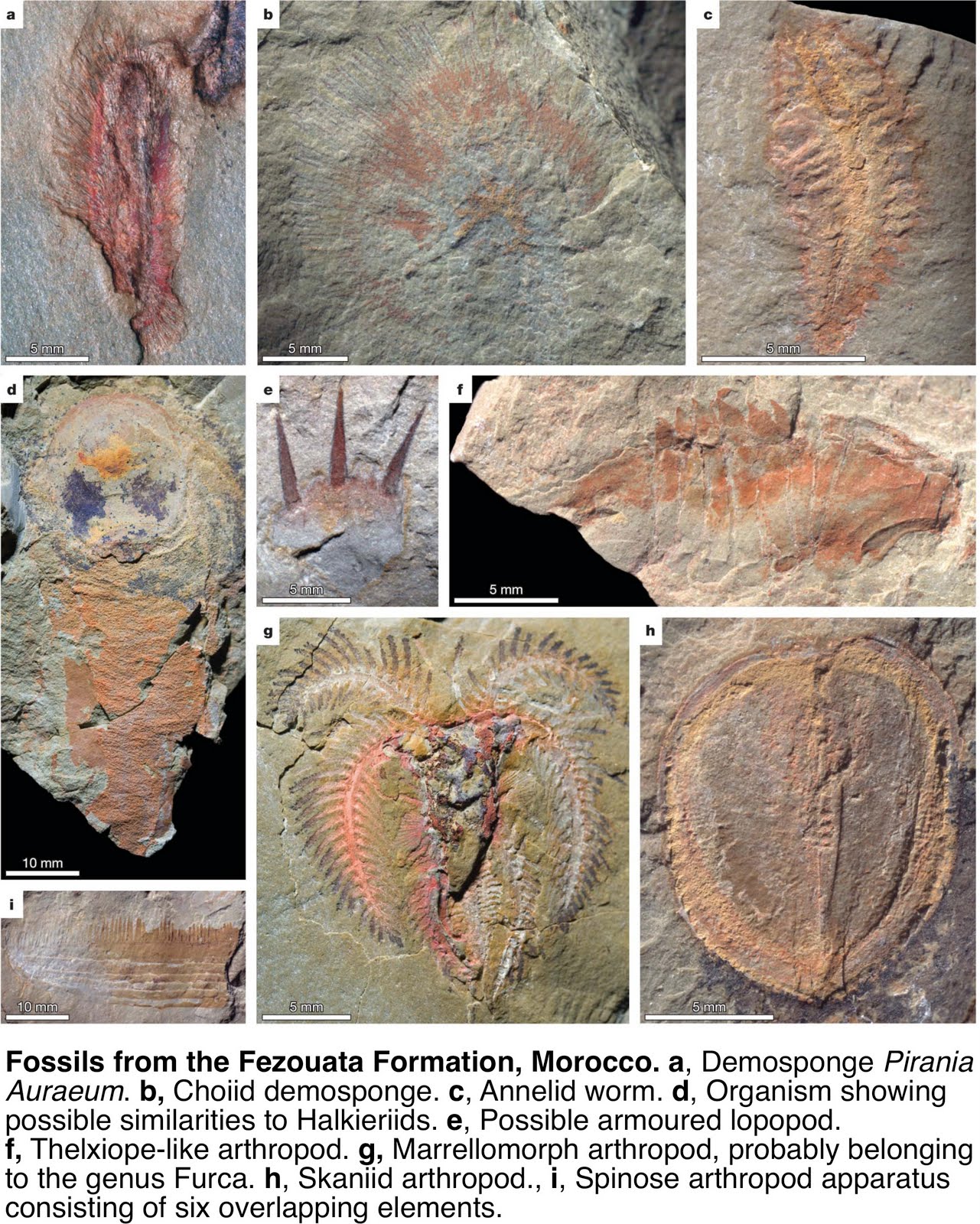

One cool find is a xiphosurid (a horseshoe crab - everyone's favourite chelicerate). The horseshoe crab fossils are the oldest yet found, suggesting that their roots may dip into the Cambrian. What is really cool is that one of the two species of horseshoe crab has a fully segmented opisthosoma (it is either partially or fully fused in other forms), suggesting evolution from a segmented ancester. The other has a fully fused preabdomen (quite a derived feature) and is similar to existing forms (though not the same.)

This has major implications for the transition from Cambrian fauna to the Palaeozoic fauna represented by Ordovician forms. Namely that the Cambrian critters hung on for a considerable time after the end of the Cambrian and intermingled with Ordovician forms. So there was no wholesale replacement at the end of the Cambrian. Both sets mixed.

However it is interesting to note that this deep water deposit was close to the South Pole during lower Ordovician times. The deposits represent a deep, cold water environment. Cambrian deposits with exceptional preservation, by contrast, were primarily from low latitudes, near the paleoequator, and from shallow water.

It may be that the Fezouata biota represents a refuge for the Cambrian forms - much like modern brachiopods are excluded from tropical areas and are mainly found in temperate and cold deep water today.

So this biota shows that Cambrian forms persisted well into the Ordovician, but a shallow water site of exceptional preservation is needed to see if the Cambrian critters were mixing it with the Ordovician upstarts, or were just hanging on along the margins.

Thanks to Paul H.

Van Roy, P., Orr, P., Botting, J., Muir, L., Vinther, J., Lefebvre, B., Hariri, K., & Briggs, D. (2010). Ordovician faunas of Burgess Shale type Nature, 465 (7295), 215-218 DOI: 10.1038/nature09038

Saturday, May 15, 2010

Cambrian Critters in the Ordovician

There's a paper in Nature on a new Ordovician site with a range of critters resembling Cambrian fossils.

I am waiting to get my hands on a copy of the paper to comment, but until then Brian Switek has it covered here.

One thing though. The deposit is apparently from deep water. This may well be an example of critters being forced out of the near shore by competition and hanging on in a deep water 'refuge'.

More once I get the paper.

Monday, April 26, 2010

Palaeoporn 14

Ménage à trois!

These are Estangia bilobata trilobites from the Lower Cambrian Emu Bay Shale on Kangaroo Island, South Australia. Estangia is the most common fossil found in the Emu Bay Shale. However, these came from the outcrop of Emu Bay Shale at Emu Bay, and not from the more famous site further along the coast that contains exceptionally preserved fossils such as Anomalocaris and Myoscolex. (The Emu Bay Shale outcrops at two locations on Kangaroo Island)

These little critters show the difference between the two depositional sites. The site with exceptional preservation shows evidence - palaeontological (whole specimens, low diversity) sedimentological (fine grained sediments), and chemical (evidence of reducing environment-enriched trace elements) - of a low energy, low oxygen environment conducive to exceptional preservation.

On the other hand at Emu Bay the site shows evidence of a higher energy, higher oxygen depositional environment. This is because the sediments show more interbedded sands and silts (coarser grained therefore higher energy), oxidating environment-enriched trace elements, and the fossils do not show exceptional preservation, and are fragmented.

In the example above, the fossils assemblage comprises the heads of three Estangia trilobites (the lower one is both turned over and spun through 180 degrees). The heads are not complete. The sides of the head - the librigena (or the free cheeks) are missing. This shows that the heads represent molts.

Trilobites are arthropods and so have to molt the outer exoskeleton in order to grow. To do this, they have special lines of weakness in the exoskeleton called sutures. When the trilobite molts, these suture lines break apart, allowing the trilobite to leave the exoskeleton. These sutures are particularly obvious on the head where they run from the margin down to the eye, around the eye and then back out to either the side margin or the back margin.

In this case the suture lines are opisthoparian,
as they run from the eye to the back of the head rather than out to the side They run along the eye so that the eyes will be the first thing to break out of the old exoskeleton - allowing the trilobite to keep its vision while the molting process continues. This results in the librigena breaking away from the head. Often the molting process breaks the attachment between the head and the rest of the body, resulting in the head becoming detached from the rest of the body.

Since these fossils comprise the cranidium only (head minus the librigena), this indicates that they are molts and that they have been sorted by currents that have separated them from the body and librigena.

Compare this with another Emu Bay Shale Estangia, this time from the site of exceptional preservation (right).

Here the head and body is present. However, it is still a molt because the librigena have been freed from the head. In this specimen, the right librigena (outlined) is still associated with the body but has moved some distance away, and is both turned over and spun through 180 degrees so the the spine (that normally points backwards) now points forwards.

So the three in the top image represent a disarticulated random grouping, and have not been caught in flagrante delicto. So move along . . . nothing to see here . ..

Diagram credit:
Trilobite Facial Sutures

Sunday, April 18, 2010

Possible Association Between Multivitamins and Breast Cancer

It's well known that the primary result of taking vitamins is basically expensive urine (e.g. here), despite alternative medicine sites claiming it's a myth.

However, now there may potentially be a much more serious downside to multivitamins than just expensive urine - breast cancer.

A study published in the American Journal of Clinical Nutrition studied 35,000 women over a 10-year period.

In 1997, 35,329 cancer-free women completed a self-administered questionnaire that provided information on multivitamin use as well as other breast cancer risk factors.

During a follow-up, 974 women were diagnosed with incident breast cancer. When researchers checked, they found that women using multivitamins were over-represented. For those taking at least seven vitamin pills per week, the risk of contracting breast cancer increased by 19 percent in comparison with those who did not take vitamins at all.

The study concluded that the results suggest multivitamin use is associated with an increased risk of breast cancer, and that this observed association is of concern and merits further investigation.

It is known that some women who use multivitamins get firmer breasts than other women, through an increase in breast tissue density, and significant increases the density of breast tissue is a strong risk factor for breast cancer.

This is not a causal link, but, as the study concludes, needs further investigation.

Complimentary health is a A$2.5 billion industry in Australia.


Multivitamin use and breast cancer incidence in a prospective cohort of Swedish women. Susanna C Larsson, Agneta Åkesson, Leif Bergkvist and Alicja Wol. American Journal of Clinical Nutrition, March 24, 2010. doi:10.3945/ajcn.2009.288

Saturday, April 10, 2010

Helpful Hints when Protecting Pedophiles

Don't leave a paper trail.

The ongoing PR disaster that is the current revelations about the pedophile priests cover up by the Catholic Church has now drawn Ratzinger even more into the frame.

The BBC is reporting on a letter delaying action on a priest in America in 1985, and signed by then Cardinal Ratzinger. The first evidence of direct involvement by Ratzinger.

According to the BBC, in 1978 a catholic priest Stephen Kiesle was sentenced to three years of probation for lewd conduct with two young boys in San Francisco. The Oakland diocese had recommended Kiesle's removal in 1981 but that that did not happen until 1987.

Cardinal Ratzinger took over the Congregation for the Doctrine of the Faith, which deals with sex abuse cases, in 1981.

So the diocese asked for the Kiesle to be defrocked in 1981. In 1985 Ratzinger wrote to the diocese:
Most Excellent Bishop

Having received your letter of September 13 of this year, regarding the matter of the removal from all priestly burdens pertaining to Rev Stephen Miller Kiesle in your diocese, it is my duty to share with you the following:

This court, although it regards the arguments presented in favour of removal in this case to be of grave significance, nevertheless deems it necessary to consider the good of the Universal Church together with that of the petitioner, and it is also unable to make light of the detriment that granting the dispensation can provoke with the community of Christ's faithful, particularly regarding the young age of the petitioner.

It is necessary for this Congregation to submit incidents of this sort to very careful consideration, which necessitates a longer period of time.

In the meantime your Excellency must not fail to provide the petitioner with as much paternal care as possible and in addition to explain to same the rationale of this court, which is accustomed to proceed keeping the common good especially before its eyes.

Let me take this occasion to convey sentiments of the highest regard always to you.

Your most Reverend Excellency

Joseph Cardinal Ratzinger

So . . , like . . , 'we think the arguments are grave, but we need more time, think about how the Church would look if we defrocked him, consider the impact on him, and be sure to minister to him'.

Nothing about protecting the flock that placed their trust in the Church and who may be in harms way.

Now the Church claims that this must be taken in context of a long series of correspondence on this matter between the Vatican and the diocese, and this is true. There may be other letters laying out protections for the flock, but if there are, surely the Vatican could release them?

Monday, April 5, 2010

Catholic Sycophancy 101

The latest PR disaster that is the Catholic church continues unabated. And much of it has to be put at the feet of Ratzinger. Confirming once again what a terrible "choice" he was. I put choice in inverted commas because, of course it was no such thing.

Having run the Vatican for several years while the incumbent Pope was literally a dribbling idiot, he successfully entrenched the fundamentalists in power behind the scenes. Having done so, the majority had unelectable sycophants, while all the best candidates were moderate and so blocked by Ratzinger's faction. Having created the impasse Ratzinger graciously steps up to the plate for the good of the Church - his church of course.

The problem with surrounding yourself with sycophants is that, well, their qualifications are that they are sycophants, not that they have experience or expertise with the issues.

This has been highlighted by the series of PR disasters the Vatican continues to stumble through.

The welcoming back into the Church of a holocaust denier.
The excommunication of people involved with saving the life of a 12 year old rape victim.
The ongoing falsehoods regarding condoms and AIDS in Africa.

Now comes the latest scandels, the continuing revelations of pedophilia by Catholic priests and the failure by the church to deal with it.

This time Ratzinger is intimately involved, as it appears he was informed about these activities but failed the victims. In fact, he apparently issued an letter in 2001 instructing that all case should be kept quiet and dealt with within the church (now I'm no lawyer, but isn't instructing someone to hide a crime, itself a crime?)

Clearly the Catholic church holds it's priests to a different standard to everyone else. That standard appears to be 'all priests are considered innocent until the crime becomes public'.

The latest attempts at damage control continues the inept performance of this Pope and the Vatican.

The victims have been blamed.
The media has been blamed.
The holocaust has been invoked to support the church.
The 'the fact that some boys were pubescent means that it wasn't pedophilia' defence. (No, seriously!).

The latest defence - change the story. It's now all about atheism

And with that we welcome the latest sycophant to be promoted - Bishop Anthony Fisher OP, DD, BA(Hons), LLB, BTheol(Hons), DPhil, the new Bishop of Parramatta, and historical ignoramus.

In his first easter message The good Bishop says:
Last century we tried godlessness on a grand scale and the effects were devastating. Nazism, Stalinism, Pol-Pottery, mass murder, abortion and broken relationships: all promoted by state-imposed atheism or culture-insinuated secularism, the illusion that we can build a better life without God.
Natzism? Really? The army that had "Gott Mit Uns" on their uniform was godless?

The new Bishop of Parramatta, on message and clueless - should go far in Ratzinger's brave new world.

Monday, March 8, 2010

New Ediacaran Trace Fossils

ResearchBlogging.orgA paper in Geology has just reported a new type of trace fossils from the Ediacaran of Mistaken Point, Newfoundland.

This is interesting because until now trace fossil diversity in the Ediacaran has been very limited, with only three recognised traces fossil types:

1) Helminthoidichnites
The most common from, composed of simple groove traces with levees. Probably formed in the topmost 10mm of the sediment. They are commonly preserved as negative epireliefs or negative hyporeliefs, indented into the bottom of the overlying beds. Sediment is commonly displaced to form marginal raised ridges. There were probable tubes indicating organisms that may have been round. Some directional meandering is evident.


2)Radulichnus
A form with fine ridges, arranged in fans and associated with Kimberella in a few instances. Broadly analogous to mollusc radula-like grazing. Kimberella occurs at the apex of the fans and appears to have scraped bio-material from the sediment with a proboscis.


3) Resting traces, particularly Dickinsonia
Evidence of serial mat "feeding" dissolution by creeping mat-like animals. These are outlines of organisms that have been impressed into algal mats covering the sediment, often in association with similar-sized body fossils. These are often found as positive epirelief - sticking out from the under side of the bed, as apposed to normal Dickinsonia body fossils which are found as negative epirelief - an indentation into the bottom of the bed.


The latest finds from Newfoundland have been found on the top of green mudstone overlain by a volcanic tuff which has protected the traces. If should be noted that the preservation at Mistaken point differs from most Ediacaran sites in that the fossils are preserved on the top of beds, under a volcanic tuff which blanketed the forms when alive and protected them. Most Ediacaran fossils occur on the base of coarse sandstone beds which smothered the organisms (see An Introduction to the Ediacaran Fauna).

Over 70 straight traces, ranging from 1.5 to 17.2 cm in length and up to 13 mm in width have been found. The surfaces of the traces are marked by regular crescentic internal divisions, formed by thin ridges of siltstone with a spacing of approx. 1 mm.
Locomotion trace from Mistaken Point Formation, Newfoundland.
A) Largest observed trail on bedding plane. B–D are
close-up images of crescentic internal divisions in A. B) Distal end of
trail. Note pyrite crystals embedded in ash surrounding trail. C) Central
section of trail. D: Proximal section of trail with terminal circular
impression. Scale bars = 1 cm.

Each trace typically bears marginal ridges which the authors claim provides key evidence for movement of an object along the surface of the sediment, and can be used to distinguish trace fossils from abiogenic structures. At the far end of several specimens, a negative circular impression can also be seen, which the authors interpret as the mould of the trace maker itself.

The largest trace on the trace-bearing bedding plane, Mistaken Point Formation, Mistaken Point Ecological Reserve, Newfoundland, Canada. Note the clear terminal disc (at right), prominent marginal levees indicating displacement of sediment, and the positive internal crescentic ridges.

The authors interpret the trace as being made by a cnidarian-like organisms similar to Urticina, a modern sea anemone.

Modern actinian (Urticina) trails in mud, produced in our
marine aquaria. Note concave-forward hemispherical structures
(at left) and positive marginal ridges (right).
Scale bar = 3 cm.

This is a big claim - that a cnidarian-grade organism was crawling around the Ediacaran. Of course a number of people have been claiming that this level of organisation was around then, but this would be an important step in supporting evidence.

There are a few issues however.

These traces are extremely rare, and are not found in other locations. An explanation for that is the differing preservatonal styles, but even so, some similar finds would be expected. Also a number of finds of tube-like remains have been found along with the 'stitch and groove' pattern shown by the Mistaken Point forms, and have been interporeted as body fossils. So there is still some uncertainty here. Of course, finding a sea-anemone-like form at the end of one of these trails would be nice, but there is still a lot we need to understand about stitch and groove forms before we can say with any degree of certainty that these forms were made by cnidarian-grade organisms

Images
Helminthoidichnites: http://en.wikipedia.org/wiki/Ediacara_biota
Dickinsonia trace: www.evolbiol.ru/fedonkin_metazoa.htm

Liu, A., Mcllroy, D., & Brasier, M. (2010). First evidence for locomotion in the Ediacara biota from the 565 Ma Mistaken Point Formation, Newfoundland Geology, 38 (2), 123-126 DOI: 10.1130/G30368.1

Wednesday, February 10, 2010

Deltoid in the Top Thirty

Our very own Deltoid has made it onto a list of the top thirty science blogs at the Times Online.

Polite applause.

Unfortunately, the Times cannot resist a nod to its climate-denialist stance and has included the truly woeful climate-denialist blog Watts Up With That.

The comments make for interesting reading (and I agree with some of them that Times Online should replace Watts Up With that with Bad Science.)

Wednesday, January 13, 2010

Creationists Lose Again

In 2005 the Association of Christian Schools International (ACSI) sued the University of California who had decided that their school qualifications were unsuitable as entry qualifications. This was due in part, to the use of creationist-leaning biology textbooks published by Bob Jones University Press and A Beka Books (including Biology: God's Living Creation and and Biology for Christian Schools.

Michael Behe was an expert witness for the ACSI, with Donald Kennedy and Francisco J. Ayala expert witnesses for UC.

The trial judge granted the defendants' motion for summary judgment, and the ACSI appealed.

The Appeals Court affirmed the trial court's ruling that the University of California's policy was constitutional.

Money quote

"The plaintiffs have not alleged facts showing any risk that UC's policy will lead to the suppression of speech. ... the plaintiffs fail to allege facts showing that this policy is discriminatory in any way. ... The district court correctly determined that UC's rejections of the Calvary [Baptist School] courses [including a biology class that used Biology: God's Living Creation] were reasonable and did not constitute viewpoint discrimination. ... The plaintiffs assert a myriad of legal arguments attacking the district court's decision, all of which lack merit."

So no change there then.

Another victory against creationism, but as Larry Moran keeps saying, the fact that these battles are being undertaken in court is a failure, despite the fact that we keep winning.

Also this is the second time Michael Behe has been an expert witness for the loosing side.

More on this from the NCSE

Tuesday, January 12, 2010

Palianation

Sarah Palin joins Fox News.

Like noone saw that coming!