The 2010 Atheist Global Convention will be held down under in Melbourne. Speakers include Richard Dawkins and Philip Adams.
They are currently taking expressions of interest to estimate numbers, so go over to the site and express yours. Oh yeah, someone called PZ Myers will also be there.
The Wilkins will also probably be there. He will even sign his book if you ask him.
Tuesday, August 18, 2009


Sunday, August 16, 2009
Badges Wot I Have Earned
Go over to science scouts and check out how many you've earned.

Troop Badge. This is a natural. I woz a geologist therefore I drank.

The talking science badge. Another easy one. used to be on Talk.Origins, and just this week regailed co-workers with the fact that swine flu is long and thin and not spherical (thanks to ERV)

The “Nyah nyah nyah nyah nyah, I’ve got a TV gig” badge. The latest one is here.

The “I blog about science” badge. Well duh!

The “destroyer of quackery” badge. I spent way too much of my academic life on the Talk.Origins newsgroup.

The “I can be a prick when it comes to science” badge. Just ask the geology mapping student groups I used to lead. "No we will not be using the formation names so you can cheat by looking up the geological maps" - bastard!

The “inordinately fond of invertebrate” badge. Not many vertebrates in the Ediacaran and Lower Cambrian. Besides, many say it was a mistake to come down from the trees, some say the move out of the oceans was a bad idea. Me, I say the stiffening of the notochord in the Cambrian was where it all went wrong, it was all downhill from there.

The “respect me - I’ve published at an upper tier publication for popular science readership” badge. This is a bit tricky as I don't know the circulation figures, but I nominate the journal Geology and this paper.

The “have used a dental drill and I’ve never been a dentist” badge. Used to clear matrix away from fossils - WEEEEEEEEEEEEEEEEE. Used for several years with no ill effects. What? WHAT? YOU'LL HAVE TO SPEAK UP . .

The “science has forced me to seek medical attention” badge. Well there was 10 kilos of fossils in the backpack, a trail bike and a sheep. Please I don't like to talk about it. Can you say Bennett's Fracture?

The “has done science whilst under the influence” badge. In geology, the most productive field work is done after dark under the influence of alcohol and a raging fire.

The “science deprives me of my bed” badge (LEVEL III). Got this one easy with field work in the Flinders Ranges and on Kangaroo Island.

The “rock licker” badge. Still the best way to tell claystone from siltstone.
13, and there are a couple of ones I could have gone for. I beetz the ethical palaeontologist who still is a palaeontologist! I don't think she's really trying . . .


13, and there are a couple of ones I could have gone for. I beetz the ethical palaeontologist who still is a palaeontologist! I don't think she's really trying . . .
Thursday, August 6, 2009
Sam the Koala dies
Sadly, Sam the Koala was put to sleep at 1.00 pm this afternoon.
She was supposed to undergo surgery for abdominal cysts associated with chlamydia. However, the vet treating Sam found that her condition was worse that thought, with inoperable damage to her urinary and reproductive tract. As she was in considerable pain, it was decided to put Sam to sleep.
She was supposed to undergo surgery for abdominal cysts associated with chlamydia. However, the vet treating Sam found that her condition was worse that thought, with inoperable damage to her urinary and reproductive tract. As she was in considerable pain, it was decided to put Sam to sleep.
Sam the Koala - a turn for the worse
Sam the Koala, rescued from the Victorian bush fires earlier this year and famous for taking a drink from a passing fire fighter, will under go a serious operation today (Thursday), and the prognosis is not good.
Sam has been diagnosed with abdominal cysts associated with urogenital chlamydiosis. This is not associated with the injuries Sam received in the fire, from which she has been making a good recovery.
Urogenital chlamydiosisa is, unfortunately, a common disease amongst Koalas and can be fatal, hence the decision to operate.
The people treating Sam are not optimistic for her survival.
Monday, August 3, 2009
Religion in Australian Politics
There is an opinion piece in today's Australian Financial Review by Geoffrey Barker, visiting fellow at the Strategic and Defence Studies Centre at the Australian National University, about religion in Australian politics. It's behind a fire wall, and much of it relates to specific Australian examples, but some is of general interest and is excerpts are provided below.
It is time Australians paused to consider the possible adverse consequences of unleashing the politics of faith on the essentially secular activity that is democratic politics. They include intolerance, authoritarianism and poisonous social division.
Some religious teachings are doubtless important in informing some political views. But allowing political conflict to be expressed as clashes of secredly ordained beliefs rather than of socially acquired interests is a recipe for non-negotiable disputes that defy the necessary compromises of political life.
A democratic society should respect the faith-based commitments of citizens; it should respect their views of religious leaders on contentious issues like abortion, censorship and social justice. It should also respect the views of non-believers.
What it cannot do is concede that any faith group possesses a monopoly on truth and virtue and allow it to impose its attitudes on the entire society. Politics arises from diversity; to eliminate diversity is to legitimise authoritarianism.
It is not necessary to have religious convictions to be tolerant and compassionate and to observe high standards of moral responsibility. Indeed, so-called humanists (much maligned by religious authoritarians) can reasonably claim to have views grounded in logic and experience rather than in rules revealed by divine intervention.
Tolerance to opposing views, and the willingness to accommodate them, are defining characteristics of democratic politics that are anathema to religious fundamentalists.
[. . .]
Sadly many Australians seem willing to swallow uncritically the religious avowals of politicians. Yet it is hardly cynical to conclude such politicians often use religion opportunistically to advance their political careers.
Moreover, those seriously demanding spiritual virtues have absolutely no appeal to politicians pursuing personal glory and earthly power.
Sunday, August 2, 2009
RU486 approved in Italy
The BBC is reporting that the drug RU486 has been approved by the Italian Pharmaceuticals Agency for use in Italy.
Nothing special about a state pharmaceuticals agency approving a drug for use, except this is Italy and RU486 is otherwise known asthe morning after pill, or the abortion pill.
RU486 available in Italy! Wow!
Kudos to the Italian Pharmaceuticals Agency, who in a 4-1 decision to approve, stated that "the task of protecting the well-being of citizens ... must take precedence over personal convictions."
The drug will not be available over the counter, but will only be available in hospital under the supervision of a doctor.
The Catholic Church has, of course, come out strongly against the decision. They could not threaten the Italian Pharmaceuticals Agency directly to influence the decision, as that's, like, illegal. So it's done the next best cowardly thing. The Vatican has threatened to excommunicate any doctor, nurse, or woman involved in taking RU486.
Well done the Italian Pharmaceuticals Agency. Another small step in removing the Catholic Church from women's uteruses
Nothing special about a state pharmaceuticals agency approving a drug for use, except this is Italy and RU486 is otherwise known as
RU486 available in Italy! Wow!
Kudos to the Italian Pharmaceuticals Agency, who in a 4-1 decision to approve, stated that "the task of protecting the well-being of citizens ... must take precedence over personal convictions."
The drug will not be available over the counter, but will only be available in hospital under the supervision of a doctor.
The Catholic Church has, of course, come out strongly against the decision. They could not threaten the Italian Pharmaceuticals Agency directly to influence the decision, as that's, like, illegal. So it's done the next best cowardly thing. The Vatican has threatened to excommunicate any doctor, nurse, or woman involved in taking RU486.
Well done the Italian Pharmaceuticals Agency. Another small step in removing the Catholic Church from women's uteruses
Thursday, July 9, 2009
Blogging "the Ediacaran Biota"
The Radio 4 program "In our Time" is running a program on "the Ediacaran Biota". I'm blogging this as initial thoughts right after the program. It can be heard here.
 Oh dear. The photo that accompanies the show on the web site (shown here on the right) has a Dickinsonia costata, but it is upside down! The large segments are considered the head end. So this Dick is doing a head stand!
And it's bad start as they can't pronounce the name correctly. They are pronouncing it "Edi-aaa-car-raaan with long 'a' sounds. It's not pronounced like that. The term is an indigenous Australian word which is pronounced Edi-ak-ra, with the last 'a' pronounced like the last 'a' in Russia, and the middle 'a' not pronounced at all, or Edi-ak-ran with 'ran' pronounced as in "he ran away". All the 'a' sounds are harsh and short. The name means "reedy waterhole'" (Edi- means waterhole).
Ony one of the three guests has worked on Ediacaran fossils, and there are no Australians - they might have got at least one on the phone!
OK, there is a lot of talk about how the appearance of shelly fossils in the Cambrian is sudden, and that this was a problem for Darwin. This is misleading.
It has to be put in context.
The early mapping of what was recognised as the Cambrian rocks (from the name of the Latin name for Wales, where the section was mapped) and became the "Type Section" (the reference section agains which all other sections of the same age around the world are compared), did show that there was a rapid transition from 'barren' 'pre-Cambrian rocks to fossiliferous Cambrian rocks, replete with trilobites, sea shells and other relatively complex organisms.
This rapid transition is what they are talking about, and was the one familiar to Darwin - he actually traversed these Cambrian rocks with the Reverent Adam Sedgewick (who named the Cambrian Period and who was well aware that this represented the earliest evidence of life in the fossil record).
The important point here is that, yes fairly complex fossils appear quite abruptly in this rock section, BUT, the section is incomplete. Basically the section is missing a good deal of the earliest Cambrian rocks. In other words the basal rocks containing the emergence of the Cambrian biota are missing from this area. It's like starting a book at chapter 3 - the introductory chapters have been ripped out at this place.
Rock sections in other places around the world which contain the earliest Cambrian rocks, show a transition from trace fossils, to complex trace fossils to small shelly fossils which comprise bits of the armour of larger organisms, to full body fossils.
This transition has a lot to do with the acquisition of hard parts by organisms - by the process of biomineralisation, where calcium carbonate and calcium phosphate are incorporated into the outer tissues of organisms to produce hard shells (e.g. crabs do this after they molt).
So yes, Darwin conceded that such a rapid transition to complex fossils was a difficulty for his theory, but we now know that the rapid transition he was referring to is an artifact of an incomplete rock record in that area.
There are several references to the Ediacaran biota appearing right after the last major 'snowball Earth' glaciation in the pre-Cambrian. This is incorrect.
The last 'snowball Earth' glaciation ended about 650 million years ago, the earlest Ediacaran biotas appear some 50 million years after that and, in fact, there is some evidence for intervening glacial episodes - albeit not as extensive as the 'snowball earth' ones.
The answer to the question, "Is the Ediacaran biota a failed experiment?" was answered pretty well. Short answer - no.
Longer answer - they lasted for some 40 million years but the bulk of them were done in by a changing environment which took away the conditions required for their preservation as fossils, and the rise of predation (with the rise of mineralisation of tissues allowing jaw elements to be carbonate tipped). However a few groups survived to pass on their genetic legacy to future groups.
Summary, not a bad show all in all. Recommended if you are interested in the Ediacarans.
Wednesday, July 8, 2009
Ediacara on the Radio
No, not me!
John Wilkins has alerted me to the fact that the subject of the next "In Our Time" Radio 4 (UK) broadcast with Melvyn Bragg will be on "The Ediacara Biota".
The broadcast will be on from 9.00 - 9.45 am (British Summer Time) on Thursday 9th July, and will be repeated at 9.00 pm the same day.
If you miss it, you can listen to it at any time afterward from the same link above.
Thursday, July 2, 2009
"Don't Cry For Me, Anteater . . . "
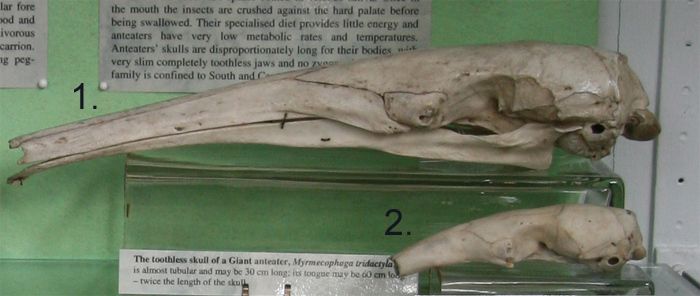
In the previous post, TamanduaGirl, commented that it looked like the tear duct in the anteater skulls figured was outside the orbit, unlike other placental mamals.
Actually the tear duct is on the inner part of the orbit (where the orbit bone slopes towards the eye). It's difficult to see on a two-dimensional image, but I've enhanced the image below.

In each image, the tear duct is actually the smaller hole (ringed in the lower image) - the larger hole is a nerve opening. In each instance, the duct is positioned just slightly on the inner side of the orbit. The limit of the orbit is indicated with a dotted line in the lower image.
In the image linked to appears to be a cast, and, as such, only shows the larger nerve opening and not the tear duct. Small openings are often missing from casts.
More on monotreme-marsupial-placental evolution soon.
Actually the tear duct is on the inner part of the orbit (where the orbit bone slopes towards the eye). It's difficult to see on a two-dimensional image, but I've enhanced the image below.

In each image, the tear duct is actually the smaller hole (ringed in the lower image) - the larger hole is a nerve opening. In each instance, the duct is positioned just slightly on the inner side of the orbit. The limit of the orbit is indicated with a dotted line in the lower image.
In the image linked to appears to be a cast, and, as such, only shows the larger nerve opening and not the tear duct. Small openings are often missing from casts.

More on monotreme-marsupial-placental evolution soon.
Tuesday, June 30, 2009
And now you don't (again)
In a previous post I talked about the position of the tear duct in placental mammals verses marsupials, and how the duct was outside the orbit in marsupials, but inside the orbit in placentals. Someone asked what was the condition in monotremes, which was a good question. I didn't know the answer and had to wait until a recent trip to Adelaide to be able to access a monotreme skull to find out.
The answer is that, in monotremes, the duct is inside the orbit, just like placentals.
 The skull of an Echidna (above) shows the duct to be inside the orbit. In an actual specimen, the duct is placed in the bone surface sloping into the orbit (not clear on a two-dimensional photo). In a marsupial the duct would be clearly visible outside the orbit.
So there you go, only marsupials have the duct visible outside the orbit.
So the question now is, how do you tell a placental anteater skull from an Echidna skull?
The answer is that the Echidna is far more bird-like than the anteater, and the cranium tends to slope sharply downward at the front in the Echidna, but tends to be much flatter in the anteater (see below).

Photo credit
Echidna - University of Washington
Anteater - Natural History Museum, London
The answer is that, in monotremes, the duct is inside the orbit, just like placentals.
 The skull of an Echidna (above) shows the duct to be inside the orbit. In an actual specimen, the duct is placed in the bone surface sloping into the orbit (not clear on a two-dimensional photo). In a marsupial the duct would be clearly visible outside the orbit.
So there you go, only marsupials have the duct visible outside the orbit.
So the question now is, how do you tell a placental anteater skull from an Echidna skull?
The answer is that the Echidna is far more bird-like than the anteater, and the cranium tends to slope sharply downward at the front in the Echidna, but tends to be much flatter in the anteater (see below).

Photo credit
Echidna - University of Washington

Anteater - Natural History Museum, London
Subscribe to:
Posts (Atom)