 Another problematic Cambrian form finds a home. Once more the Burgess Shale comes up trumps, with the work of Martin Smith and Jean-Bernard Caron from the University of Toronto/Royal Ontario Museum shedding new light on Cambrian critters and the evolutionary things they get up to.
 Ok. This is neat, and a group that occurs in the Burgess Shale, the Emu Bay Shale, and Chengjiang. The Burgess Shale form Nectocaris pteryx, and the closely related forms Vetustovermis from the Lower Cambrian Emu Bay Shale,
 and the now not-synonymous Petalilium from the Lower Cambrian Chengjiang fauna, has been re-interpreted as a stem group cephalopod.
 The arguments in favour of the forms being stem group cephalopods is persuasive (stem group forms lack one or more features characteristic of the last common ancester of the crown group).
The forms have a number of characters that link them with molluscs, and closely with cephalopods. These include the presence of tentacles - albeit only one pair, an axial cavity containing gills (possibly homologous with the mantle cavity of crown group cephalopods), and a funnel
They are also rare – ninety-odd specimens from the Burgess Shale may seem a lot, but it isn’t really. The Emu Bay Shale form Vetustovermis is very rare. I didn’t find one decent specimen when I worked on the deposit. But rare is good if you are trying to push the mollusc line, because molluscs don’t moult. Arthropods do. And moulds can fossilise. In effect, this is like leaving numerous photocopies of yourself in the fossil record. One arthropod can leave numerous fossils behind. Molluscs can’t. So we would expect them to be rarer than arthropods, as is the case here.
The eyes are interesting. They are preserved differently that other eyes in the Burgess Shale. Usually, eyes are preserved as a carbon film coated by clay minerals. This is similar to body preservation and is taken to indicate that the eyes were compound (made of calcite crystals) and thus robust enough to preserve the same way as the body. In Nectocaris (as in the similar Chengjiang form Petalilium) the eyes are preserved as a carbon film that covers a thick layer of muscovite crystals. This is interpreted by the authors as indicating that the eyes were hollow in life, similar to cephalopod (and our) eyes today, rather than the compound eyes of arthropods.
Another nice feature is the serial repeated pairs of gills. Modern cephalopods have one gill, or set of gills, but the sequence of repeated pairs of gills in Nectocaris (and in Petalilium, and Vetustovermis) is exposing its common ancestry with segmented forms. In other words the common ancester of molluscs and arthropods was a metamerically segmented form (a form with a series of similar segments, like a trilobite or worm). Nectocaris, with its sequence of repeated pairs of gills, is therefore, a neat intermediary between the metamerically segmented ancestral form and the derived, more modern forms that have lost the segmentation. In mean, if you'd have asked a palaeontologist what a stem group cephalopod would look like, the answer would have been paired gills all the way down!
This group appears to lack a horny beak, a radula, a shell, and at least eight tentacles, which is why they are considered stem group forms. The last common ancester of the cephalopods is considered to have had all of these.
I have a few issues however.
First, have to say I’m not a fan of the paper’s title, Primative soft-bodied cephalopods from the Cambrian. “Primitive”! Oh dear, I had though we had stopped using that term – Early perhaps). And they are not strictly cephalopods (they are however, Conchifera). So, "Early Conchiferids from the Cambrian" perhaps (a bit dry I’d admit), or my personal choice, "Squid wannabes from the Cambrian".
Second, I am not a fan of the reconstruction either. Not the drawing itself – I’m a big fan of Marianne Collins’ work – but of the way it hovers with the funnel aimed downward like a Harrier Jump Jet or, as in Nature News and Views, the rocket underneath the Space Shuttle. Ugh!
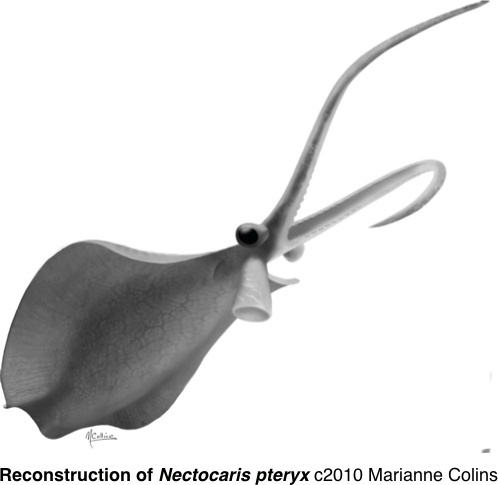
It’s very unlikely that the funnel would have been used like that. One of the specimens has it in that position (figure “f” in first image) but it is unlikely to represent the life position. Burgess Shale fossils are found in all orientations, and numerous other specimens of Nectocaris have the funnel in various orientations. I think that figure “f” has a bad case of flacid funnel, probably post mortem.
The funnel was probably used to move forwards and backwards, but also maybe to blow fine sediment away from shallowly buried prey, or even blow them so that they tumbled which disorientated them, make them easier to catch. But what prey did they hunt? This is especially interesting given the jaws, or rather the lack of them! Which brings us to . . .
Third, where’s the jaws? It looks like they are absent in Nectocaris. This is strange, as the presence of teeth or radulas are well established in the Mollusca by the Middle Cambrian Burgess Shale time. Modern cephalapods have a beak, but the radula is reduced in octopus, and is absent (or extremely reduced) in Spirula, the Ram’s Horn Squid.
The authors say that the absence could be due to it not being preserved or that it is too small to preserve. I’m not buying that it didn’t preserve. Hard parts of other organisms preserve just fine in the Burgess Shale. But it could be that they were very small. Spirula is a small (around 4 cm) deep water squid that either has a very small or non-existant radula. Spirula feeds on plankton, so it could be that Nectocaris also fed on tiny plankton as well.
There is some vague feature which the authors claim could be mouth parts. If so it would suggest a diet of soft bodies organisms or very small organisms such as plankton.

So three Cambrian forms tidied up quite nicely, and a neat transitional form (gasp!) as well! Cambrian squid wannabes with a hangover from their metamerically segmented ancestry.
Smith, M., & Caron, J. (2010). Primitive soft-bodied cephalopods from the Cambrian Nature, 465 (7297), 469-472 DOI: 10.1038/nature09068
Smith, M., & Caron, J. (2010a). Primitive soft-bodied cephalopods from the Cambrian: Supplimentary Information Nature, 465 (7297), 469-472 DOI: 10.1038/nature09068
Chen, Jun-yuan; Huang, Di-ying; Bottjer, David J. (2005). "An Early Cambrian problematic fossil: Vetustovermis and its possible affinities.". Proceedings of the Royal Society, Part B 272 (1576): 2003–2007. doi:10.1098/rspb.2005.3159.


